
Insights from Siby K. Joseph
A Note on the Context
These clarifications come from Dr. Siby K. Joseph, a dedicated Gandhian scholar associated with the Sevagram Ashram Pratishthan in Wardha, Maharashtra, and Global Gandhi.
This collection was born out of a real-time conversation in the context of an ongoing fast in Delhi. A group of young scholars and activists reached out to him to make sense of the deep moral, political, and spiritual questions surrounding Mahatma Gandhi’s historic fasts. Dr. Siby Joseph shared these vital insights to help them understand how Gandhi viewed the strict discipline, ethical boundaries, and intense spiritual nature of a fast.
Q1. What was fasting according to Mahatma Gandhi?
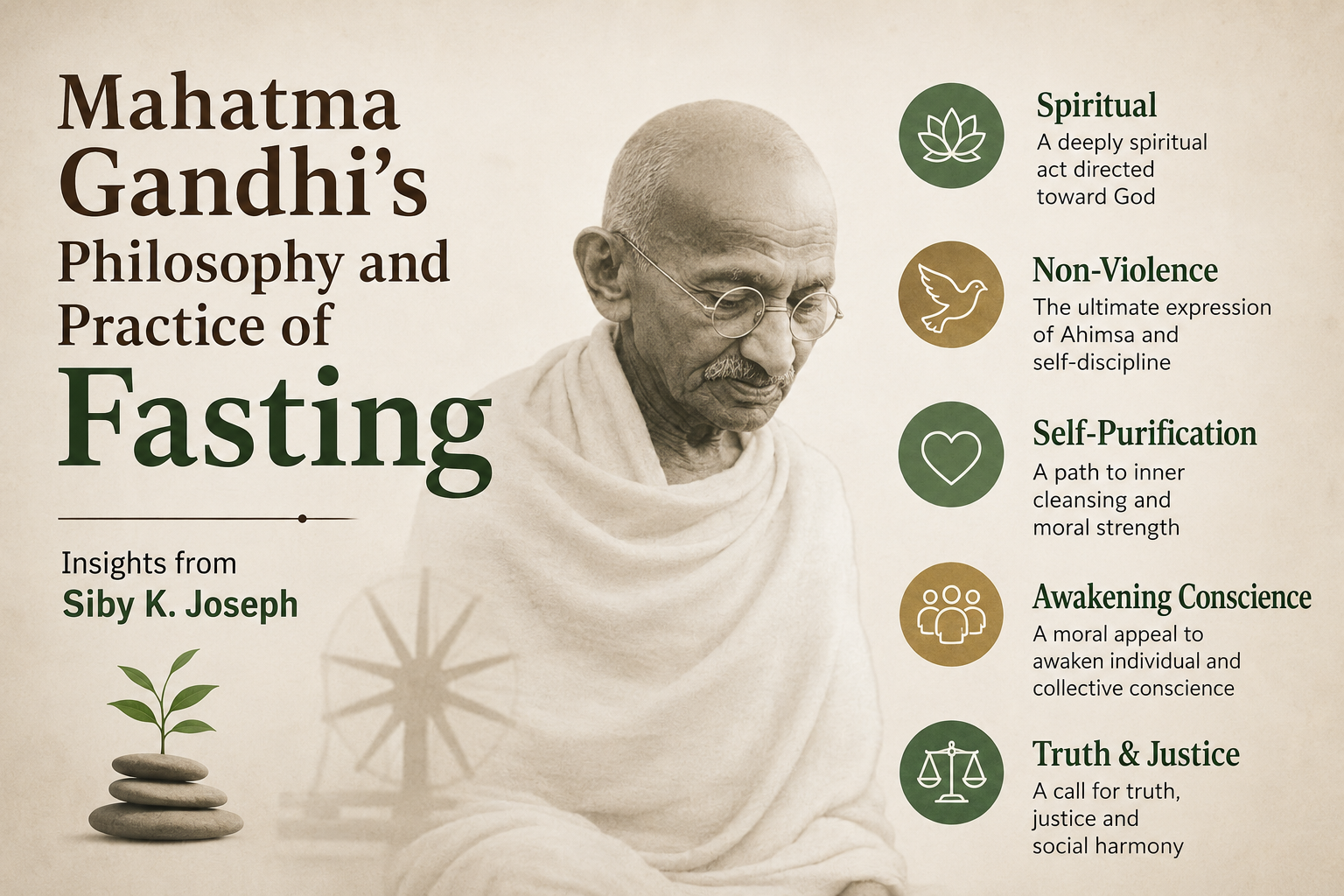
Answer: Mahatma Gandhi viewed fasting as a deeply spiritual, deliberate, and powerful act of non-violence (Ahimsa). Rather than a mere physical or political tool, it was the ultimate resort—the “last weapon” in the armoury of a satyagrahi—to be deployed only when all human ingenuity and conventional efforts had failed.
Fundamentally, Gandhi saw fasting as a spiritual act directed toward God that “quickens” or intensifies the spirit of prayer. On a public level, it served as a mechanism to awaken the collective conscience. When a respected leader fasted, it acted as a profound moral wake-up call, rousing the “sleeping conscience” of the masses and forcing them to confront systemic injustices or moral lapses.
Crucially, a true fast could never be undertaken out of anger or political opportunism; it had to be executed in strict obedience to the “dictates of the inner voice.” This divine intuition ensured the action remained deliberate and prevented reckless haste. Gandhi openly acknowledged the inherent danger of fasting—specifically, that the public might act against their own true will or convictions out of mistaken sympathy just to save the faster’s life. However, he maintained that this danger must be faced squarely, asserting that a practitioner must never be deterred from right action when convinced of its absolute moral correctness.
Q2. Did Mahatma Gandhi use fasting as a means to politically blackmail the British Government?
Answer: No. The accusation that Mahatma Gandhi used fasting as a form of “political blackmail” or an “easy way out” was explicitly levelled against him by the Viceroy, Lord Linlithgow. Gandhi, in his letter dated February 7, 1943, written from his detention camp at the Aga Khan Palace, fiercely rejected this charge, characterising it as the imputation of a “base and cowardly motive.”
Gandhi’s fasting was never a coercive mechanism designed for political extortion or personal gain. Instead, it was a transparent, deeply spiritual “appeal to the Highest Tribunal [God] for justice.” He resorted to this extreme measure only because the conventional channels of dialogue and justice—embodied by the adversarial colonial administration—had completely failed, leaving no room for constitutional engagement. Thus, the fast was a defensive moral protest against an autocratic regime, rather than an aggressive tactic of intimidation.
Historically, this 1943 fast was a direct reaction to the British Raj abandoning the fundamental rule of law. Following the launch of the Quit India Movement, the colonial government executed wholesale arrests of thousands of Congress leaders, pre-emptively blaming them for the subsequent nationwide violence without granting them a trial. Gandhi sharply critiqued this abuse of power, noting that the government had “condemned men and women before trying them and hearing their defence.” As a counter-demand, he insisted that any proof brought against the freedom fighters must “correspond to the canons of English Jurisprudence” and called for an investigation by an “impartial tribunal.”
Gandhi entered the ordeal “with the clearest possible conscience,” fully prepared to embrace death and “go to the Judgment Seat with the fullest faith in [his] innocence.” By placing his own life at stake rather than inflicting harm on his adversaries, Gandhi removed the act from the realm of political blackmail, confidently leaving the final verdict to “posterity.”
Q3. Did Gandhi undertake a fast for trivial matters like eating pakodas?
Answer: No. The incident referred to appears in a footnote to a letter written by Mahatma Gandhi to Raojibhai Patel in February 1914. The footnote reads as follows:
“A Phoenix teacher had committed a breach of ashram discipline by eating pakodas along with some students. Though she denied this lapse when questioned by Gandhiji, she confessed it the day after he had decided to go on an indefinite fast of atonement.”
In the letter itself, there is no indication that Gandhi undertook the fast simply because someone ate pakodas. Rather, his fast was a response to deeper moral issues: untruthfulness, a breach of community trust, and the wrongful suspicion of innocent children.
Gandhi stated that his tapascharya (spiritual penance) led to the “speedy discovery of truth,” adding that without it, “the poor children would not have been proved innocent as they actually were.” He did not use the fast as a punishment, but as a moral appeal to awaken the teacher’s conscience, which successfully prompted her confession. Gandhi viewed the act as a demonstration of his “faith in soul-force,” proving that even a seemingly minor pledge can evoke “pure love” and resolve deep moral conflicts within a community.
Q4. Did Gandhi use fasting as a means of protest?
Answer: Yes, Gandhi explicitly used his last fast in January 1948 as a powerful means of protest. He undertook this final penance to confront a profound societal wrong—the brutal communal violence and hatred that had gripped Delhi, turning it into a “city of the dead” and destroying the “heart friendship” that previously existed between Hindus, Sikhs, and Muslims.
Gandhi stated that a practitioner of non-violence (Ahimsa) feels impelled to fast “by way of protest against some wrong done by society” when all other remedies have failed. Explaining the spiritual nature of this final protest, he said:
“A pure fast, like duty, is its own reward. I do not embark upon it for the sake of the result it may bring. I do so because I must. Hence, I urge everybody dispassionately to examine the purpose and let me die, if I must, in peace which I hope is ensured. Death for me would be a glorious deliverance rather than that I should be a helpless witness of the destruction of India, Hinduism, Sikhism and Islam.”
Instead of using physical force, Gandhi turned the suffering inward, using his fast as a means to awaken the collective conscience of a fractured nation.