
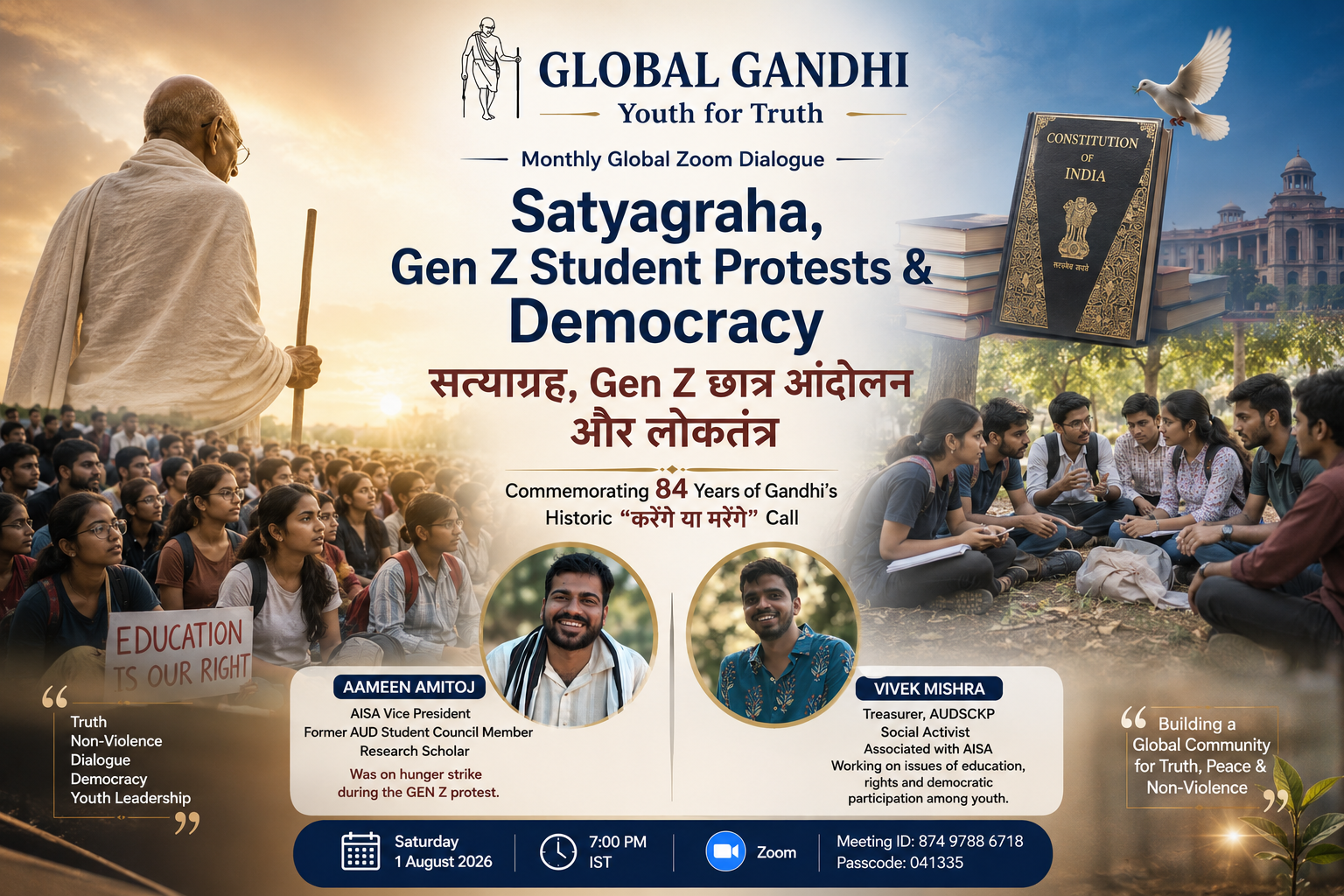
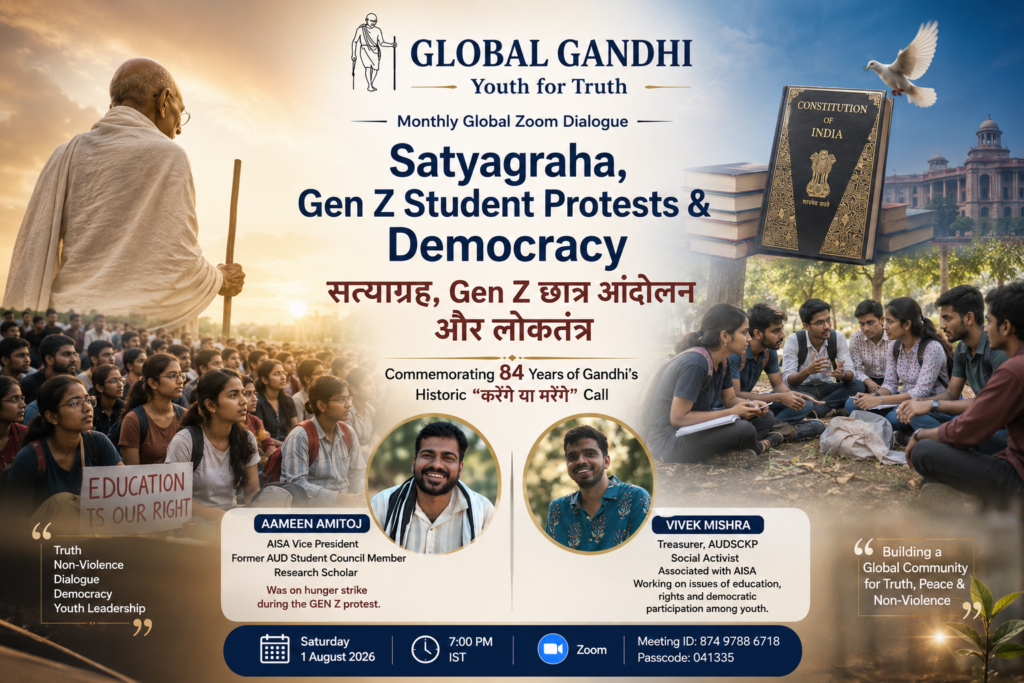
As India marked 84 years of Mahatma Gandhi’s historic “करेंगे या मरेंगे” (Do or Die) call, Global Gandhi’s latest Youth for Truth dialogue brought together students, scholars, social activists and citizens to reflect on one of the defining questions of our time:
How should young people participate in democracy while remaining committed to truth, dialogue and non-violence?
Held on 1 August 2026, the discussion explored the relationship between contemporary student movements, democratic participation and Gandhian philosophy.
Youth Voices in a Changing Democracy
Young people today face rapidly evolving educational, technological and social challenges. Questions surrounding access to quality education, employment opportunities, examination integrity and institutional accountability continue to shape public discourse.
The discussion examined how recent student movements have brought many of these concerns into the national conversation and highlighted the importance of ensuring that civic participation remains peaceful, constitutional and inclusive.
Collective Action and Civic Responsibility
Speaker Aameen Amitoj, AISA Vice President and former AUD Student Council Member, emphasized that meaningful social change cannot be achieved through isolated individual efforts alone.
He highlighted the importance of collective participation, democratic engagement and organized civic action, while also discussing the legal and constitutional dimensions that often arise during peaceful public demonstrations.
The discussion emphasized that protecting constitutional rights requires awareness, solidarity and responsible leadership.
Strengthening Democratic Participation
Vivek Mishra, Treasurer of AUDSCKP and social activist associated with AISA, focused on the importance of organization within public movements.
He stressed that successful civic initiatives require:
- Clear objectives
- Effective coordination
- Transparent leadership
- Constructive engagement
- Long-term institutional dialogue
Participants discussed the value of developing structured coordination mechanisms and clearly articulated demands for future civic initiatives.
Education Reform and Institutional Accountability
The dialogue also examined broader concerns affecting students across the country, including:
- Examination integrity
- Paper leak incidents
- Access to affordable education
- Public education reforms
- Institutional accountability
- Democratic participation within educational institutions
Participants agreed that sustainable reforms require continued dialogue among students, educators, policymakers and civil society.
Gandhi’s Continuing Relevance
One of the central themes of the discussion was the enduring relevance of Gandhian principles.
Rather than viewing Gandhi’s philosophy solely through a historical lens, participants reflected on how truth, non-violence, dialogue and civic responsibility continue to offer valuable guidance in addressing contemporary challenges.
The discussion emphasized that democratic societies become stronger when differences are addressed through respectful dialogue, constitutional methods and peaceful public engagement.
Looking Ahead
The session concluded with a shared commitment to continue meaningful conversations on education, youth leadership and democratic participation.
Global Gandhi announced that the Youth for Truth series will continue to bring together diverse voices from academia, civil society and public life to encourage thoughtful discussions rooted in truth, peace and non-violence.
In an era shaped by rapid technological and social change, the dialogue served as a reminder that democracy flourishes when young people are empowered to participate responsibly, engage respectfully and work collectively toward constructive solutions.