

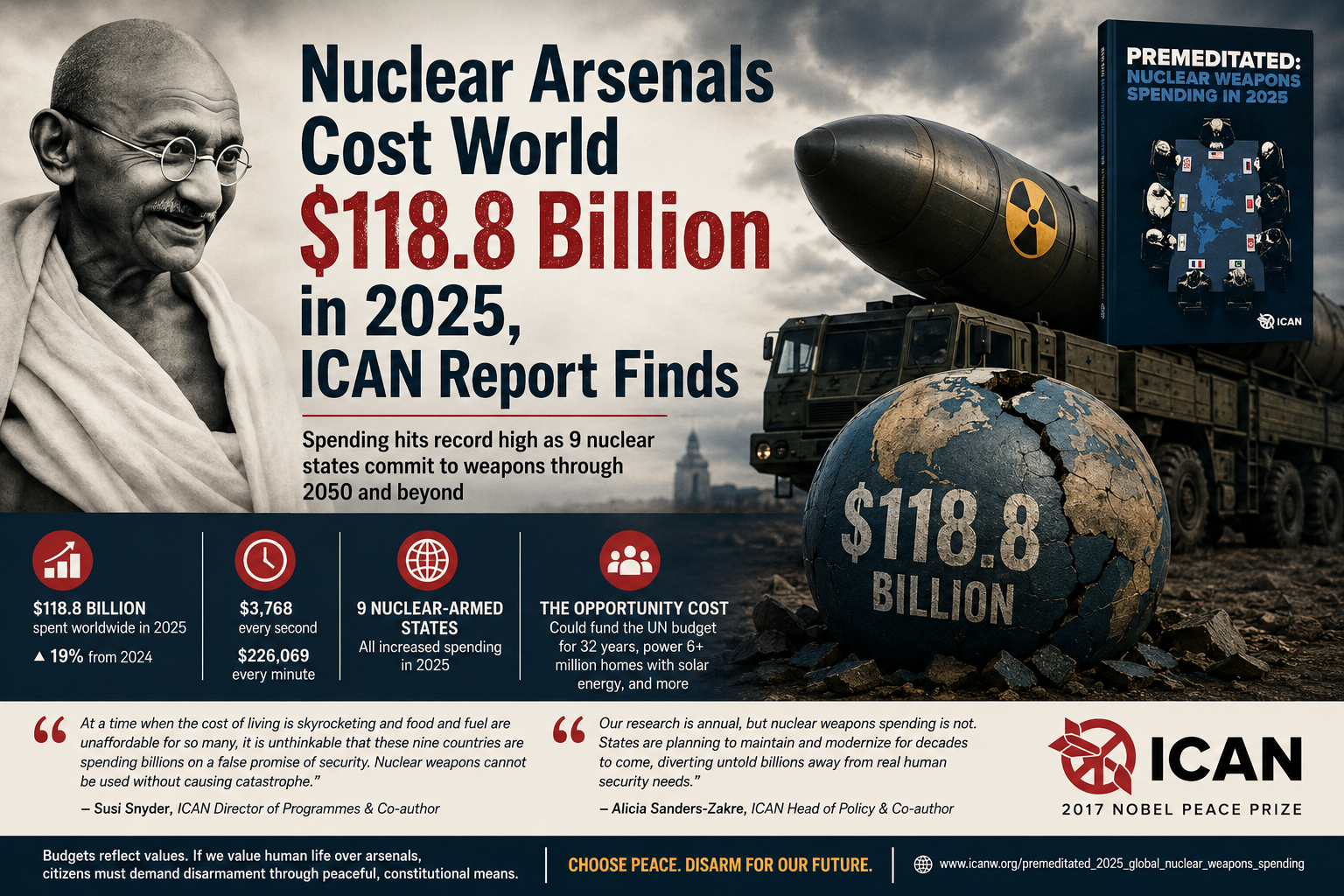
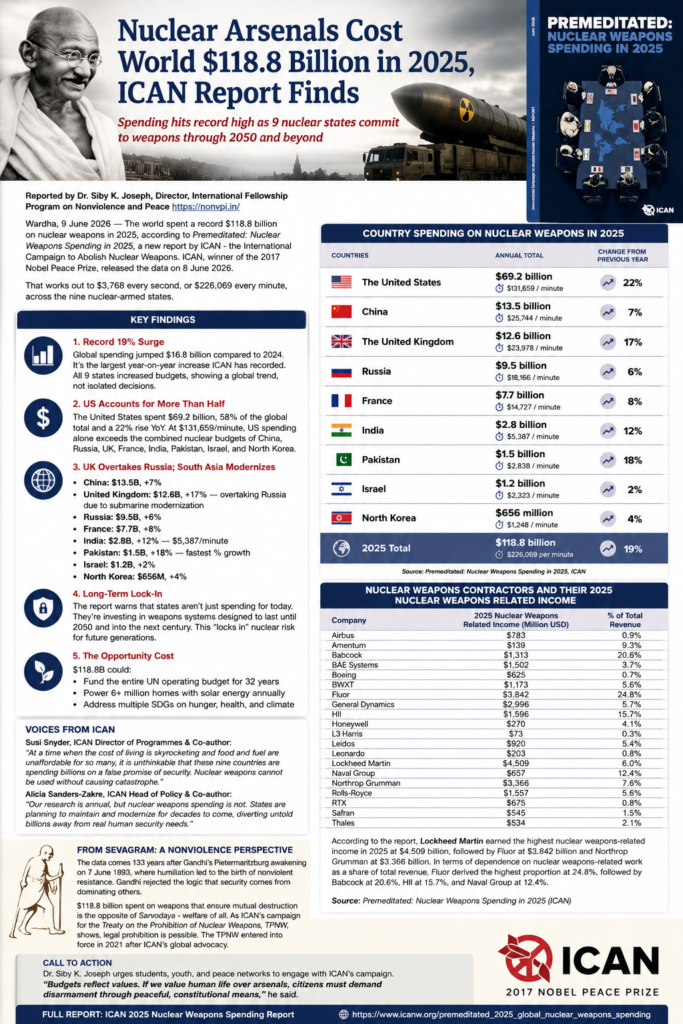
Spending hits record high as 9 nuclear states commit to weapons through 2050 and beyond
Reported by Dr. Siby K. Joseph, Director, International Fellowship Program on Nonviolence and Peace
https://nonvpi.in/
Wardha, 9 June 2026 — The world spent a record $118.8 billion on nuclear weapons in 2025, according to Premeditated: Nuclear Weapons Spending in 2025, a new report by ICAN – the International Campaign to Abolish Nuclear Weapons. ICAN, winner of the 2017 Nobel Peace Prize, released the data on 8 June 2026.
That works out to $3,768 every second, or $226,069 every minute, across the nine nuclear-armed states.
Key Findings
1. Record 19% Surge
Global spending jumped $16.8 billion compared to 2024. It’s the largest year-on-year increase ICAN has recorded. All 9 states increased budgets, showing a global trend, not isolated decisions.
2. US Accounts for More Than Half
The United States spent $69.2 billion, 58% of the global total and a 22% rise YoY. At $131,659/minute, US spending alone exceeds the combined nuclear budgets of China, Russia, UK, France, India, Pakistan, Israel, and North Korea.
3. UK Overtakes Russia; South Asia Modernizes
China: $13.5B, +7%
United Kingdom: $12.6B, +17% — overtaking Russia due to submarine modernization
Russia: $9.5B, +6%
France: $7.7B, +8%
India: $2.8B, +12% — $5,387/minute
Pakistan: $1.5B, +18% — fastest % growth
Israel: $1.2B, +2%
North Korea: $656M, +4%
4. Long-Term Lock-In
The report warns that states aren’t just spending for today. They’re investing in weapons systems designed to last until 2050 and into the next century. This “locks in” nuclear risk for future generations.
5. The Opportunity Cost
$118.8B could:
- Fund the entire UN operating budget for 32 years
- Power 6+ million homes with solar energy annually
- Address multiple SDGs on hunger, health, and climate
Nuclear Weapons Contractors and Their 2025 Nuclear Weapons Related Income
The report also highlights the significant revenues earned by major corporations involved in nuclear weapons-related work during 2025.
| Company | 2025 Nuclear Weapons Related Income (Million USD) | % of Total Revenue |
|---|---|---|
| Airbus | $783 | 0.9% |
| Amentum | $139 | 9.3% |
| Babcock | $1,313 | 20.6% |
| BAE Systems | $1,502 | 3.7% |
| Boeing | $625 | 0.7% |
| BWXT | $1,173 | 5.6% |
| Fluor | $3,842 | 24.8% |
| General Dynamics | $2,996 | 5.7% |
| HII | $1,596 | 15.7% |
| Honeywell | $270 | 4.1% |
| L3 Harris | $73 | 0.3% |
| Leidos | $920 | 5.4% |
| Leonardo | $203 | 0.8% |
| Lockheed Martin | $4,509 | 6.0% |
| Naval Group | $657 | 12.4% |
| Northrop Grumman | $3,366 | 7.6% |
| Rolls-Royce | $1,557 | 5.6% |
| RTX | $675 | 0.8% |
| Safran | $545 | 1.5% |
| Thales | $534 | 2.1% |
According to the report, Lockheed Martin earned the highest nuclear weapons-related income in 2025 at $4.509 billion, followed by Fluor at $3.842 billion and Northrop Grumman at $3.366 billion. In terms of dependence on nuclear weapons-related work as a share of total revenue, Fluor derived the highest proportion at 24.8%, followed by Babcock at 20.6%, HII at 15.7%, and Naval Group at 12.4%.
Source: Premeditated: Nuclear Weapons Spending in 2025 (ICAN)
This addition complements the report’s findings by illustrating how substantial portions of nuclear weapons spending flow to private corporations involved in the development, maintenance, modernization, and support of nuclear weapons systems.
Voices from ICAN
Susi Snyder, ICAN Director of Programmes & Co-author:
“At a time when the cost of living is skyrocketing and food and fuel are unaffordable for so many, it is unthinkable that these nine countries are spending billions on a false promise of security. Nuclear weapons cannot be used without causing catastrophe.”
Alicia Sanders-Zakre, ICAN Head of Policy & Co-author:
“Our research is annual, but nuclear weapons spending is not. States are planning to maintain and modernize for decades to come, diverting untold billions away from real human security needs.”
From Sevagram: A Nonviolence Perspective
The data comes 133 years after Gandhi’s Pietermaritzburg awakening on 7 June 1893, where humiliation led to the birth of nonviolent resistance. Gandhi rejected the logic that security comes from dominating others.
$118.8 billion spent on weapons that ensure mutual destruction is the opposite of Sarvodaya – welfare of all. As ICAN’s campaign for the Treaty on the Prohibition of Nuclear Weapons, TPNW, shows, legal prohibition is possible. The TPNW entered into force in 2021 after ICAN’s global advocacy.
Call to Action
Dr. Siby K. Joseph urges students, youth, and peace networks to engage with ICAN’s campaign. “Budgets reflect values. If we value human life over arsenals, citizens must demand disarmament through peaceful, constitutional means,” he said.
Full Report: ICAN 2025 Nuclear Weapons Spending Report
https://www.icanw.org/premeditated_2025_global_nuclear_weapons_spending