Siby K. Joseph
Akhilesh Jha’s article, titled “What two gramophones tell us about Vande Mataram,” appeared in The Sunday Express (the opinion section of The Indian Express) on August 30, 2026, creating interest and curiosity among readers who are unfamiliar with these records. I was already familiar with them because I had scanned the historical renditions of gramophone records shared from the aural stocks of Akhilesh Jha and Rashmita Jha, which appeared on the Ministry of Culture, Government of India portal commemorating 150 years of Vande Mataram. I also had the opportunity to discuss this with Akhilesh Jha when he visited Wardha in February 2026 in connection with a Vande Mataram exhibition.
He starts the narration of his piece with the Haripura Session of the Indian National Congress (INC). As I have worked on the 1924 INC session—in which Mahatma Gandhi became the president of the Congress for the first and only time—it was quite natural that some history enthusiasts asked me a number of questions relating to the subject.
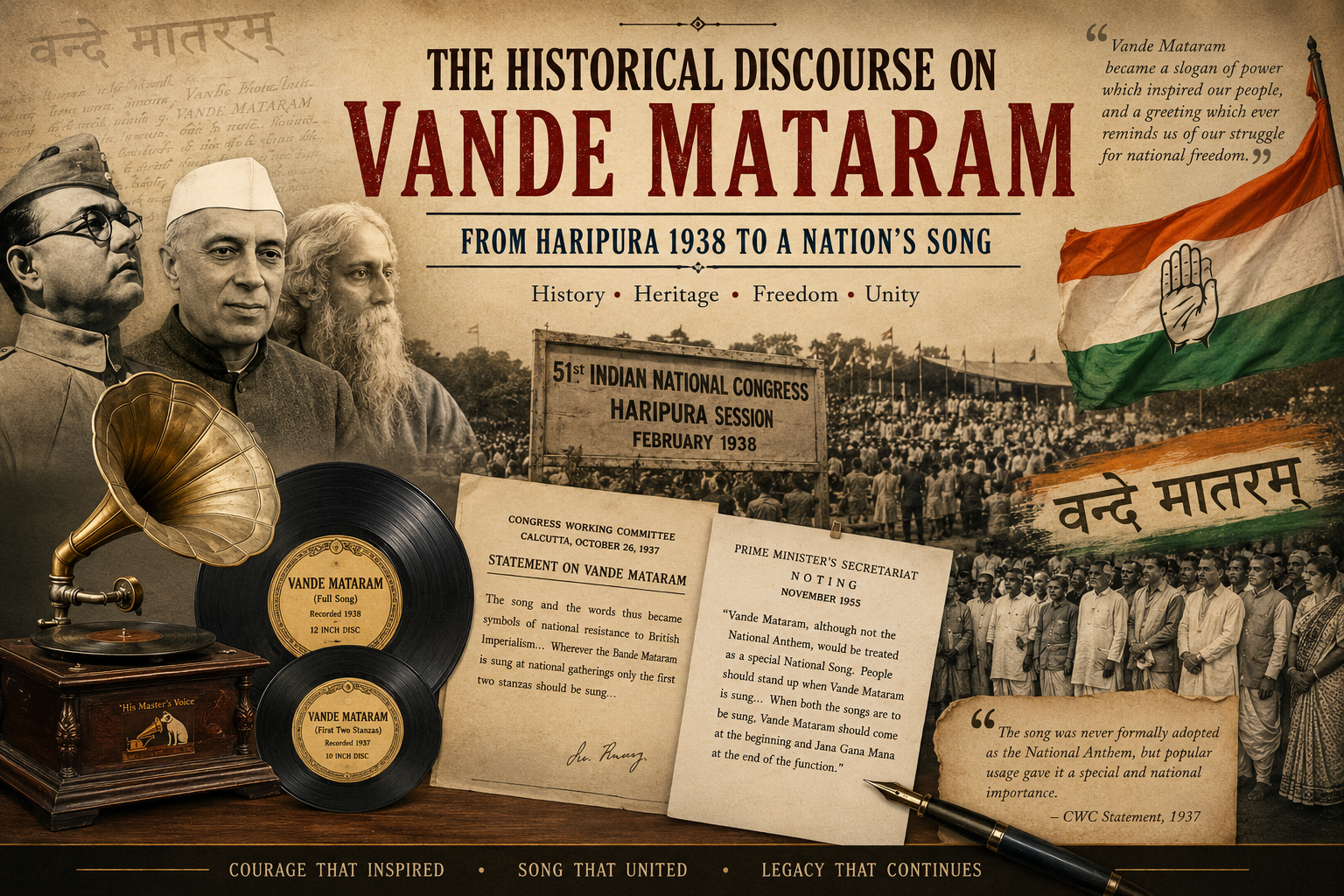
Let us start with the first question: whether Vande Mataram was reaffirmed in the Haripura Session. In the official report of the session, published for the All-India Congress Committee by Kanaiyalal N. Desai, General Secretary of the Reception Committee, 51st Indian National Congress, Haripura, Surat, Gujarat, there are only a few references to Vande Mataram.
The proceedings began with the singing of Vande Mataram. Satyamurti from Madras wired: “Illness prevents my attending. Please accept and convey my apologies. Wish Congress complete success. Vande Mataram.” On the opening day, 19th February 1938, the address of Subhas Chandra Bose closed with the salutation “Bande Mataram.” It was 11:00 p.m. when the party of musicians that came from Bengal rose to conclude the session with Vande Mataram. The whole gathering joined them while standing. The Presidential Address of Subhas Chandra Bose also closed with the salutation “Bande Mataram.” Also, it is to be noted that the whole text of Vande Mataram is not given in the report.
The author says that, “It is important to remember that the Congress had, for years, referred to Vande Mataram as the ‘National Anthem’ in the proceedings and reports of its annual sessions. Many such reports during the 1920s were edited and prepared by Pt Jawaharlal Nehru, then serving as General Secretary of the Indian National Congress.” He also makes a reference to the CWC meeting in Calcutta in 1937, where he feels that the pride and position of the song had been compromised. The Congress Working Committee, which met in Calcutta on October 26, 1937, under the presidentship of Jawaharlal Nehru, adopted a statement regarding Vande Mataram—detailing its history, its role as a symbol of resistance against British rule, the distinction of its first two stanzas, and the recommendation to sing only those two stanzas at national gatherings. The relevant text from the statement is given below in its unabridged form to help the reader understand whether the pride and position of the song had indeed been compromised:
“A controversy having recently arisen about the Bande Mataram song, the Working Committee desire to explain the significance of this song. This song appears in Bankim Chandra Chatterji’s novel Anandamatha but it has been pointed out in his biography, that the song was written independently of, and long before, the novel, and was subsequently incorporated in it. The song should thus be considered apart from the book. It was set to music by Rabindranath Tagore in 1896. The song and the words “Bande Mataram” were considered seditious by the British Government and were sought to be suppressed by violence and intimidation. At a famous session of the Bengal Provincial Conference held in Barisal in April 1906, under the presidentship of Shri A. Rasul, a brutal lathi charge was made by the police on the delegates and volunteers and the “Bande Mataram” badges worn by them were violently torn off. Some delegates were beaten so severely as they cried “Bande Mataram” that they fell down senseless. Since then, during the past thirty years, innumerable instances of sacrifice and suffering all over the country have been associated with “Bande Mataram” and men and women have not hesitated to face death even with that cry on their lips. The song and the words thus became symbols of national resistance to British Imperialism in Bengal especially, and generally in other parts of India. The words “Bande Mataram” became a slogan of power which inspired our people, and a greeting which ever reminds us of our struggle for national freedom.
Gradually the use of the first two stanzas of the song spread to other provinces and a certain national significance began to attach to them. The rest of the song was very seldom used and is even now known by few persons. These two stanzas described in tender language the beauty of motherland and the abundance of her gifts. There was absolutely nothing in them to which objection could be from the religious or any other point of view. The song was never sung as challenge to any group or community in India and was never considered as such or as offending the sentiments of any community. Indeed the reference in it to thirty crores of Indians makes it clear that it was meant to apply to all the people of India. At no time, however, was this song, or any other song formally adopted by the Congress as the National Anthem of India. But popular usage gave it a special and national importance.
The Working Committee feel that past associations, with their long record of suffering for the cause, as well as popular usage, have made the first two stanzas of this song a living and inseparable part of our national movement and as such they must command our affection and respect. There is nothing in the stanzas to which anyone can take exception. The other stanzas of the song are little known and hardly ever sung. They contain certain allusions and a religious ideology which may not be in keeping with the ideology of other religious groups in India.
The Committee recognise the validity of the objection raised by Muslim friends to certain parts of the song. While the Committee have taken note of such objection insofar as it has intrinsic value, the Committee wish to point out that the modern evolution of the use of the song as part of national life is of infinitely greater importance than its setting in a historical novel before the national movement had taken shape. Taking all things into consideration therefore, the Committee recommend that wherever the Bande Mataram is sung at national gatherings only the first two stanzas should be sung with perfect freedom to the organisers to sing any other song of an unobjectionable character, in addition to, or in the place of, the Bande Mataram song.”
Thus, the position of the CWC was that, though the song was never formally adopted as the national anthem, taking note of its popular usage and its role as a symbol of resistance, it recommended singing the first two stanzas at national gatherings.
Then, the author talks about Netaji’s association with the 1938 Bande Mataram Sampoorna recording with a 12-inch disc to restore the pride of Vande Mataram. Definitely, it is a significant piece of archival history. At the same time, it has to be remembered that it was Subhas Bose himself who wrote to Rabindranath Tagore seeking his opinion on the Vande Mataram controversy, and on 17 October, he asked Nehru to discuss the matter personally with Tagore. Here is Nehru’s reply of 20 October:
“My dear Subhas,
Your letter of the 17th. Certainly, as suggested by you, I shall discuss the Bande Mataram song with Dr. Tagore. I do not know that any formal statement is necessary by the Working Committee, but we should be clear in our own minds. I have managed to get an English translation of Ananda Math, and I am reading it at present to get the background of the song. It does seem that this background is likely to irritate the Muslims. Further, there is the difficulty of the language, which is not understood by most people. I do not understand it without the help of a dictionary.
There is no doubt that the present outcry against Bande Mataram is to a large extent a manufactured one by the communalists. At the same time, there does seem some substance in it, and people who are communalistically inclined have been affected by it. Whatever we do cannot be to pander to communalists’ feelings but to meet real grievances where they exist.
I have decided now to reach Calcutta on the 25th morning. This will give me time to see Dr. Tagore as well as other friends.”
Nehru’s reply explicitly says that the outcry against Bande Mataram is, to a large extent, a manufactured one by the communalists.
In his reply to Bose, Tagore also made his position very clear and blunt. It comes from the mouth of the great personality who popularised it:
“The core of Vande Mataram is a hymn to goddess Durga: this is so plain that there can be no debate about it. Of course Bankim Chandra does show Durga to be inseparably united with Bengal in the end, but no Mussulman can be expected patriotically to worship the ten-handed deity as ‘Swadesh’. This year many of the special [Durga] Puja numbers of our magazines have quoted verses from Vande Mataram—proof that the editors take the song to be a hymn to Durga. The novel Anandamath is a work of literature, and so the song is appropriate in it. But Parliament is a place of union for all religious groups, and there the song cannot be appropriate. When Bengali Mussulmans show signs of stubborn fanaticism, we regard these as intolerable. When we too copy them and make unreasonable demands, it will be self-defeating”
In a post script to this same letter, Tagore wrote:
“Bengali Hindus have become agitated over this matter, but it does not concern only Hindus. Since there are strong feelings on both sides, a balanced judgement is essential. In pursuit of our political aims, we want peace, unity and goodwill-we do not want endless tug of war that comes from supporting the demands of one faction over the other.”
Thus, it is evident that Tagore’s perspective was instrumental in the decision to adopt only the first two stanzas for national gatherings. Subhas Bose was deeply involved in the Congress process that accepted this formula to ensure communal amity. Netaji’s support for recording the full composition should be seen as a desire to preserve and celebrate Bankim’s complete song; at the same time, his correspondence with Tagore and Nehru demonstrated a deeper concern regarding what should be used as an inclusive national song for public functions.
The final question in this discussion is whether the Prime Minister’s Secretariat noting of November 1955 represents a departure from the language of “equal status” found in President Rajendra Prasad’s 1950 statement to the Constituent Assembly. This explanation was provided when the Madhya Bharat Government requested instructions from the Home Ministry on 24 November 1955 regarding whether Jana Gana Mana and Vande Mataram could both be sung during government functions, and if so, which should be sung at the beginning and which at the end. To ensure a clear understanding and arrive at a sound conclusion, the text of that noting is provided below:
“This question came up before the Constituent Assembly when the decision was taken to make Jana Gana Mana our National Anthem. At that time, it was stated that Vande Mataram, although not the National Anthem, would be treated as a special National Song. It was further made clear that people should stand up when Vande Mataram was sung. This was made clear by the President’s statement referred to in a note.
This of course does not mean that normally Jana Gana Mana and Vande Mataram should both be sung. But there is no objection to both of them being sung or played, if such is the desire of the organisers of a function, official or non-official.
As a rule, it would be better not to have the two at the same function, as this makes the function rather heavy. However, there is no objection to it.
When both the songs are to be sung, Vande Mataram should come at the beginning and Jana Gana Mana at the end of the function.”
The 1955 note clarifies that while Jana Gana Mana is the National Anthem, Vande Mataram holds the status of a special National Song requiring attendees to stand, and both may be performed at official or non-official functions if desired. While it is generally preferable to avoid performing both to keep the program concise, there is no objection to doing so; when both are included, Vande Mataram should precede Jana Gana Mana.
Note: This was prepared in response to the questions posed to Dr. Siby K. Joseph following the publication of Akhilesh Jha’s piece.