
A journey bringing conversations around education, examinations and employment closer to young people
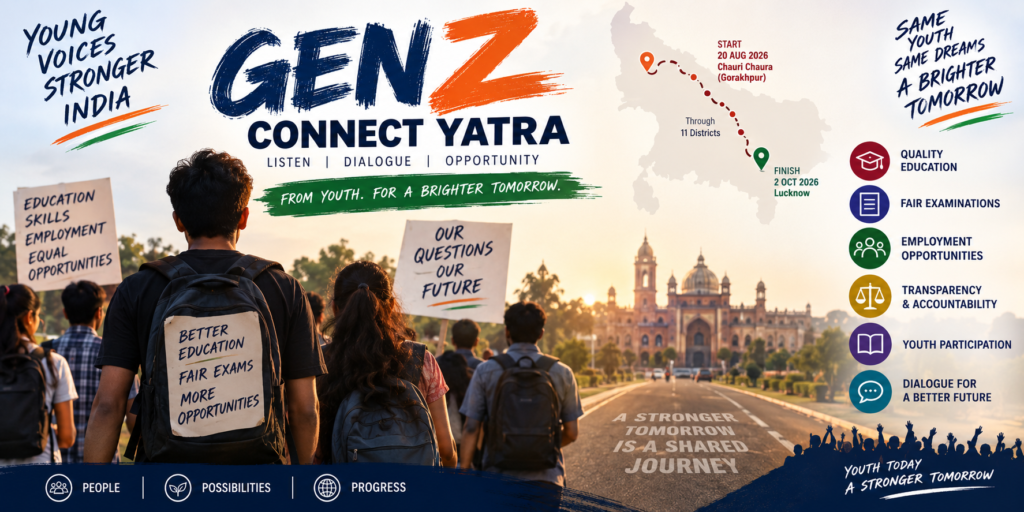
For millions of young people, education and employment are among the most important concerns shaping their future.
From school and college to competitive examinations, skill development and the search for meaningful employment, young people and their families make significant investments of time, money and effort. Questions surrounding the affordability and quality of education, recruitment opportunities, examination processes and employment have therefore become important subjects of public discussion.
The Gen Z Connect Yatra, organised by Justice Morcha, is an initiative focused on listening to young people and bringing their concerns and questions into a wider public conversation.
Why Education and Employment Matter
Education and employment are closely connected with public policy.
Schools, colleges, universities, libraries, skill-development centres, recruitment systems and employment opportunities are influenced by decisions made by governments and institutions.
The campaign document argues that young people should have access to quality education, skill development and employment opportunities across their own regions, rather than being compelled to leave their homes and families simply to study, find employment or pursue a dignified life.
This raises an important question:
How can educational and employment opportunities become more accessible, transparent and equitable for young people?
The Pressure Behind Competitive Examinations
For many families, preparing for competitive examinations is a long and expensive process.
Students preparing for examinations such as IIT, NEET, UPSC and SSC-CGL may spend several years studying and preparing. Families can invest their savings, borrow money and make other sacrifices to support them.
When examinations are delayed or cancelled, recruitment processes remain pending, or allegations of paper leaks and irregularities arise, the impact can extend far beyond the examination itself.
Young people may lose valuable years of preparation.
Families may lose significant amounts of money.
And uncertainty can affect the confidence that young people place in institutions.
The Gen Z Connect Yatra document raises these concerns and asks who should be accountable for the time, money and opportunities lost when recruitment and examination processes do not function as expected.
The Numbers Behind the Competition
The scale of competition faced by young people is enormous.
According to figures cited in the campaign document, 60,244 Uttar Pradesh Police Constable positions attracted more than 48 lakh applications, representing roughly 80 applicants for each position. The document also cites the UPPSC RO/ARO recruitment, where 411 positions reportedly attracted 10.76 lakh applicants.
The document further cites UPPSC figures stating that over a five-year period, the commission received 94.38 lakh applications while approximately 58,000 positions were filled.
Behind these figures are individual young people preparing for years, often while living away from home and paying for coaching, accommodation, libraries, books and other necessities.
The issue, therefore, is not simply about the number of applicants.
It is also about time, opportunity, financial pressure and the expectations placed on an entire generation.
What Is the Gen Z Connect Yatra?
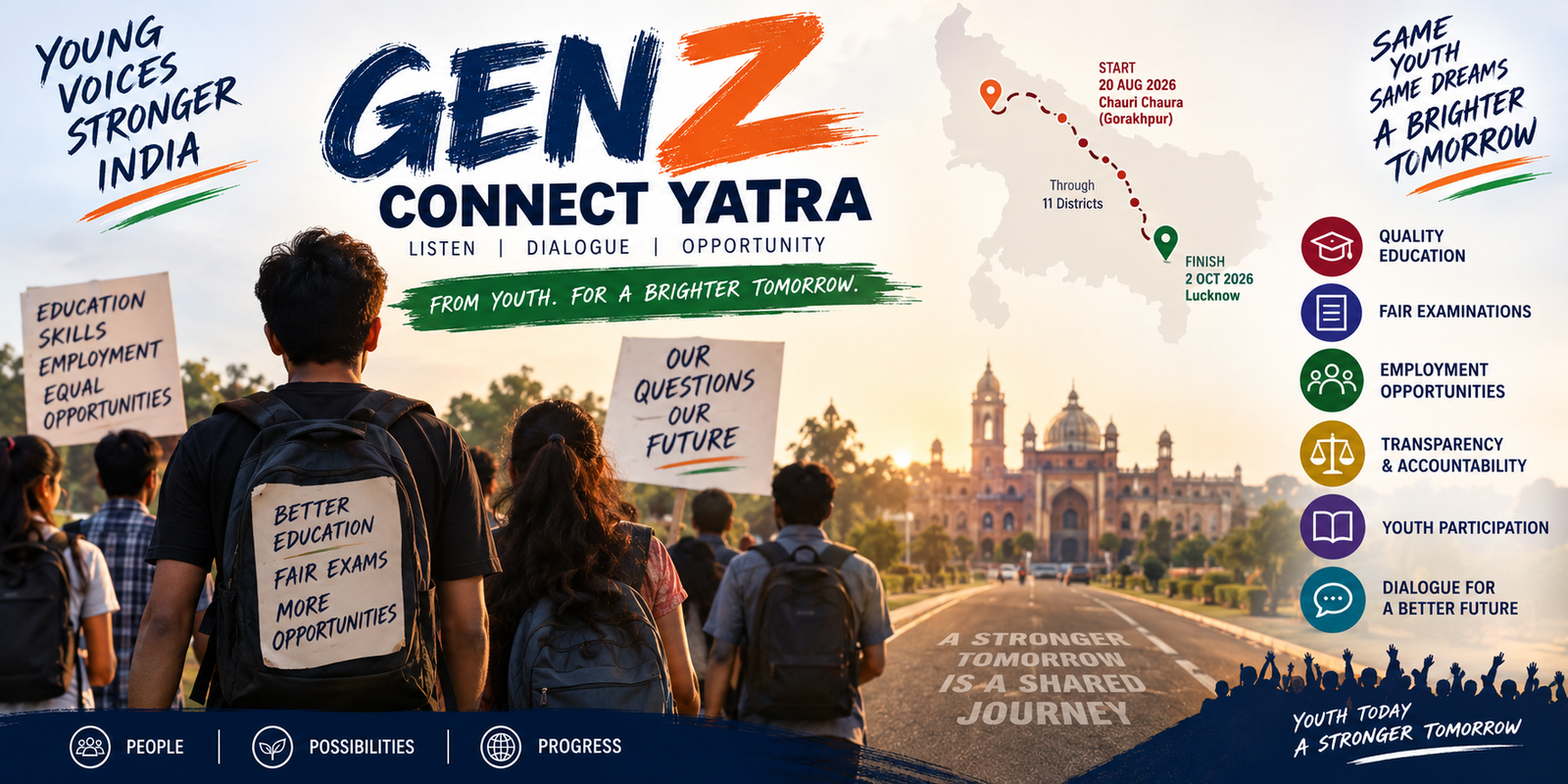
The Gen Z Connect Yatra began on 20 August 2026 at Chauri Chaura, Gorakhpur.
According to the campaign information, the Yatra is scheduled to travel through Kushinagar, Deoria, Ballia, Mau, Azamgarh, Ghazipur, Jaunpur, Varanasi, Prayagraj, Pratapgarh and Rae Bareli, before concluding in Lucknow on 2 October 2026.
The campaign also states that activities will take place across all 75 districts of Uttar Pradesh, including street-corner meetings, student-youth meetings and public dialogues involving students, competitive-examination candidates, unemployed young people, teachers, parents and different social groups.
The stated purpose is to listen to the concerns of young people, connect their questions and bring them into a wider public conversation.
The Ten Demands
The campaign has presented ten demands concerning education, recruitment, examinations and employment:
- An annual recruitment calendar with examinations conducted on time.
- Immediate filling of vacant government positions.
- Restarting delayed recruitment and appointments.
- Greater transparency in examinations, including publication of waiting lists and scorecards.
- Changes concerning the National Testing Agency (NTA).
- Withdrawal of the National Education Policy (NEP) 2020.
- Ending contract-based employment practices and implementing equal pay for equal work.
- Government-set maximum limits for private-school fees.
- Equal fellowships for researchers.
- Withdrawal of cases against students and teachers involved in movements concerning paper leaks and recruitment irregularities.
These are the demands put forward by the campaign and represent its stated position on education, recruitment and employment.
Why Youth Voices Matter
Regardless of one’s position on individual demands or policies, creating opportunities for young people to discuss the issues affecting their lives is an important part of democratic participation.
Students can share their experiences.
Teachers can discuss challenges within education.
Competitive-examination candidates can speak about the recruitment process.
Parents can explain the financial and personal pressures faced by families.
And young people can ask questions about the future they are preparing for.
The Gen Z Connect Yatra seeks to create such spaces through meetings and public interactions across Uttar Pradesh.
From Questions to Public Conversation
The challenges surrounding education and employment are not limited to one examination, one institution or one city.
They involve broader questions:
Are educational opportunities accessible?
Are recruitment processes timely and transparent?
How can young people receive better opportunities in their own regions?
How can examination systems maintain public trust?
Who should be accountable when young people lose time and resources because of delays or disruptions?
These questions deserve informed discussion involving students, teachers, families, policymakers, institutions and young citizens themselves.
A Journey Focused on Listening
The Gen Z Connect Yatra describes itself as an effort to travel among young people, listen to their experiences and connect their concerns.
Its planned route from Gorakhpur to Lucknow, together with activities across Uttar Pradesh, places young people’s experiences at the centre of the conversation.
Whether one participates directly or simply follows the discussion, the issues being raised provide an opportunity to think about the relationship between education, employment, public institutions and the aspirations of India’s young generation.
Want to Join or Learn More?

Young people, students, teachers, parents and others who would like to learn more about the Gen Z Connect Yatra or participate in its activities can connect directly with the organisers.
Gen Z Connect Yatra
🌐 Website: www.GenZConnectYatra.com
📞 Contact:
99358 13439
94522 19993