
Dr. Siby K. Joseph
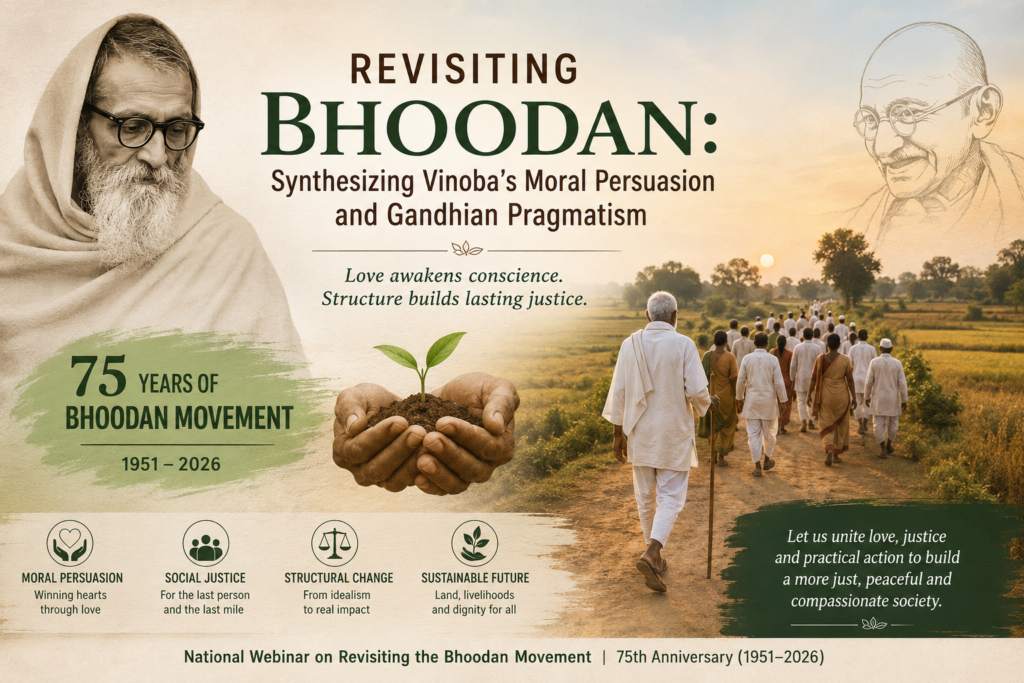
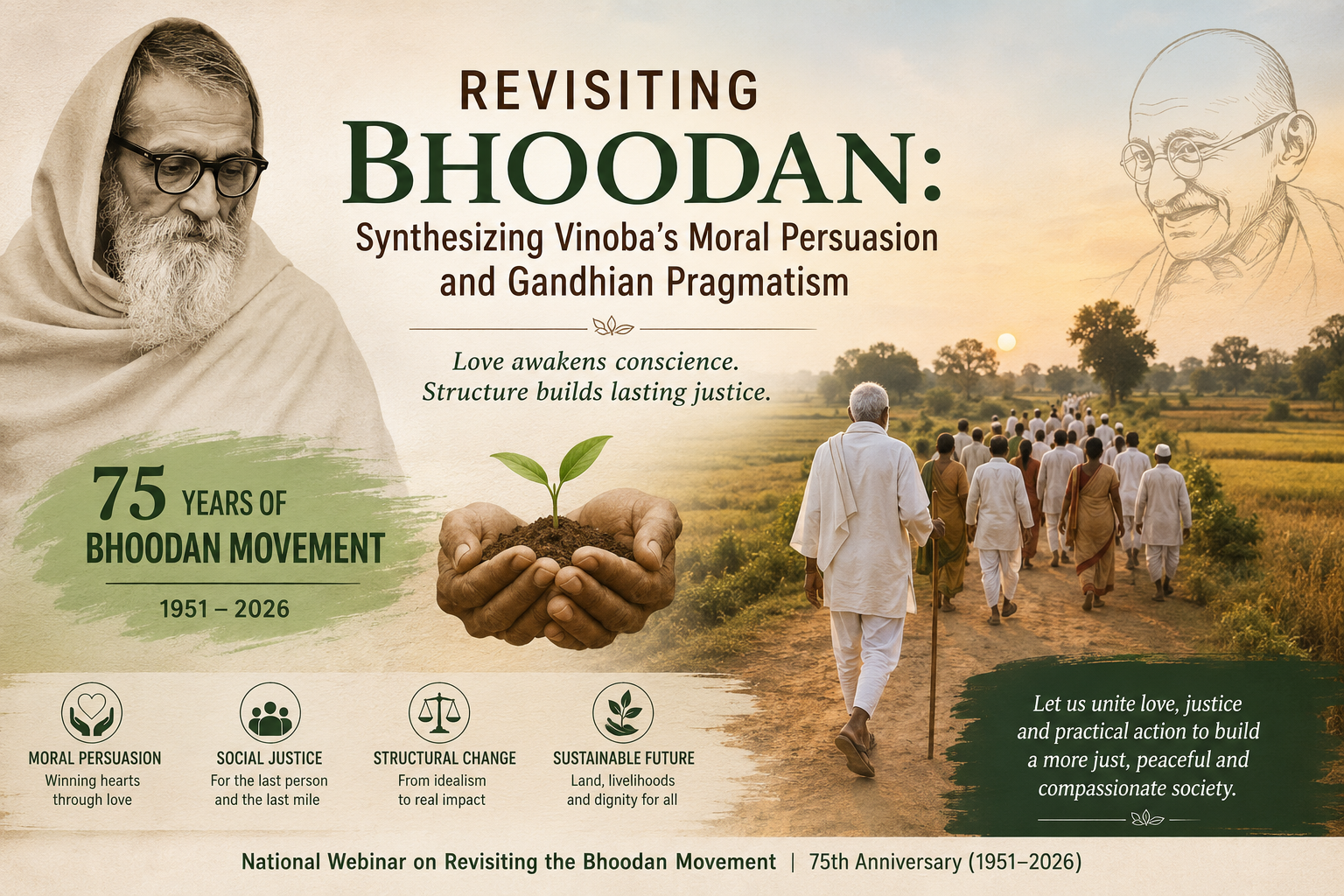
I consider it a profound honour and privilege to preside over this august National Webinar on Revisiting the Bhoodan Movement. We gather on a truly historic occasion. On 18 April 2026, we observed the 75th anniversary of the Bhoodan Movement. To mark that milestone, and at the request of Shri Ram Dutt Tripathi, former BBC correspondent, I penned an article for Media Swaraj. Following its publication, it was suggested that we organize a national-level discussion on this theme, specifically tailored to engage the younger generation.
Responding to this call, a collaborative initiative was taken by:
- Sevagram Ashram Pratishthan, Wardha
- Probhodha Trust, Kochi
- Institute of Social Sciences, MGM University, Chhatrapati Sambhajinagar
- Department of Economics, St. Xavier’s College for Women (Autonomous), Aluva
- Department of History, St. Joseph’s College (Autonomous), Irinjalakuda
As the title of our webinar suggests, our purpose today is not merely to look backward, but to look forward—drawing vital lessons from a monumental, non-violent revolutionary movement to address contemporary challenges.
Moved by Love: The Philosophy of Vinoba Bhave
There is a beautiful book titled Moved by Love, which is the English translation of Vinoba Bhave’s memoirs by Marjorie Sykes, compiled by Kalindiben. That title was not just a poetic phrase; it was Vinoba’s operational roadmap. He firmly believed that pure, active love (prem) and deep compassion (karuna) could achieve what legislative mandates often fail to secure: true social justice.
The Bhoodan Movement perfectly embodied this philosophy—it was an entire campaign moved by love. Sparked by a single, historic event in Pochampally, it evolved into a bloodless revolution. Landowners voluntarily surrendered approximately 4.7 million acres of land, writing an unprecedented and awe-inspiring chapter in human history. Today, we draw inspiration from his legacy to examine the significance of this movement in our contemporary world.
Vinoba’s movement was built entirely on a “heart-to-heart conversion.” He demonstrated that when you approach people with genuine love rather than anger or hostility, you awaken their dormant conscience. This was his simple yet profound formula: individuals begin to act generously and spontaneously, without a single weapon being drawn or a single law being enforced.
The Tension Between Idealism and Structure
Yet, looking back 75 years later, history also compels us to be honest. While love and compassion are incredible tools for lighting the fire of a movement, they cannot secure lasting social and economic justice in isolation. We require a concrete structural blueprint to translate that lofty vision into daily, sustainable reality. This critical point was rightly emphasized by Shri Naveen Kumar, Secretary of the Probhodha Trust, in his introductory remarks. Love provides the dream of an egalitarian society, but structure builds the actual road to reach it.
This brings us to a fascinating tension in our history. Mahatma Gandhi was deeply conscious of the power of the modern state, and deeply suspicious of it. In an interview with N. K. Bose, published in the Modern Review of October 1935, Gandhi famously called the State a “soulless machine” and the “symbol of violence in a concentrated form.” He felt that forcing people to be good through state power left the reform morally hollow. For Gandhi, real change had to grow organically from inside the individual and the community, allowing people to purify themselves and choose the right path.
Yet, Gandhi was also a pragmatist. He did not completely reject the role of statutory laws or regulations. In that same 1935 interview, he justified the use of minimum violence by the State against individuals who failed to behave as trustees of their wealth.
Revolutionary Realism and the Path Forward
Furthermore, in his famous interview with the American journalist and author Louis Fischer in June 1942, Gandhi asserted that in the course of the impending civil disobedience movement, peasants would stop paying taxes. He remarked, “They will make salt despite official prohibition—their next step will be to seize the land.” When probed by Fischer regarding potential violence, Gandhi candidly admitted, “There may be fifteen days’ chaos.” Regarding the confiscation of land, he averred that it would have to be done without compensation, noting that “it would be financially impossible for anybody to compensate the landlords.”
This highlights a core area for our deliberation today: What can land reforms contribute to this process through legislative means? Can we synthesize Vinoba Bhave’s gentle persuasion with Gandhi’s pragmatic realism?
This is not a mere academic debate. It is a matter of survival in a contemporary world where giant corporations are aggressively consolidating land and resources for profit, often leaving vulnerable communities behind. We are here to figure out how to resolve systemic inequalities before they erupt into bloody conflict, finding a path where love, justice, and practical structure can meet.
Thank you, and I look forward to our deliberations.
Note: This is the text of the Presidential Address delivered by Dr. Siby K. Joseph, Director, Sri Jamnalal Bajaj Memorial Library and Research Centre for Gandhian Studies, Sevagram Ashram Pratishthan, Sevagram, Wardha – 442102, Maharashtra (INDIA), during the National Webinar on “Revisiting the Bhoodan Movement” held on July 22, 2026. He can be contacted via email at directorjbmlrc@gmail.com.