
Dr. Seema Sajjan

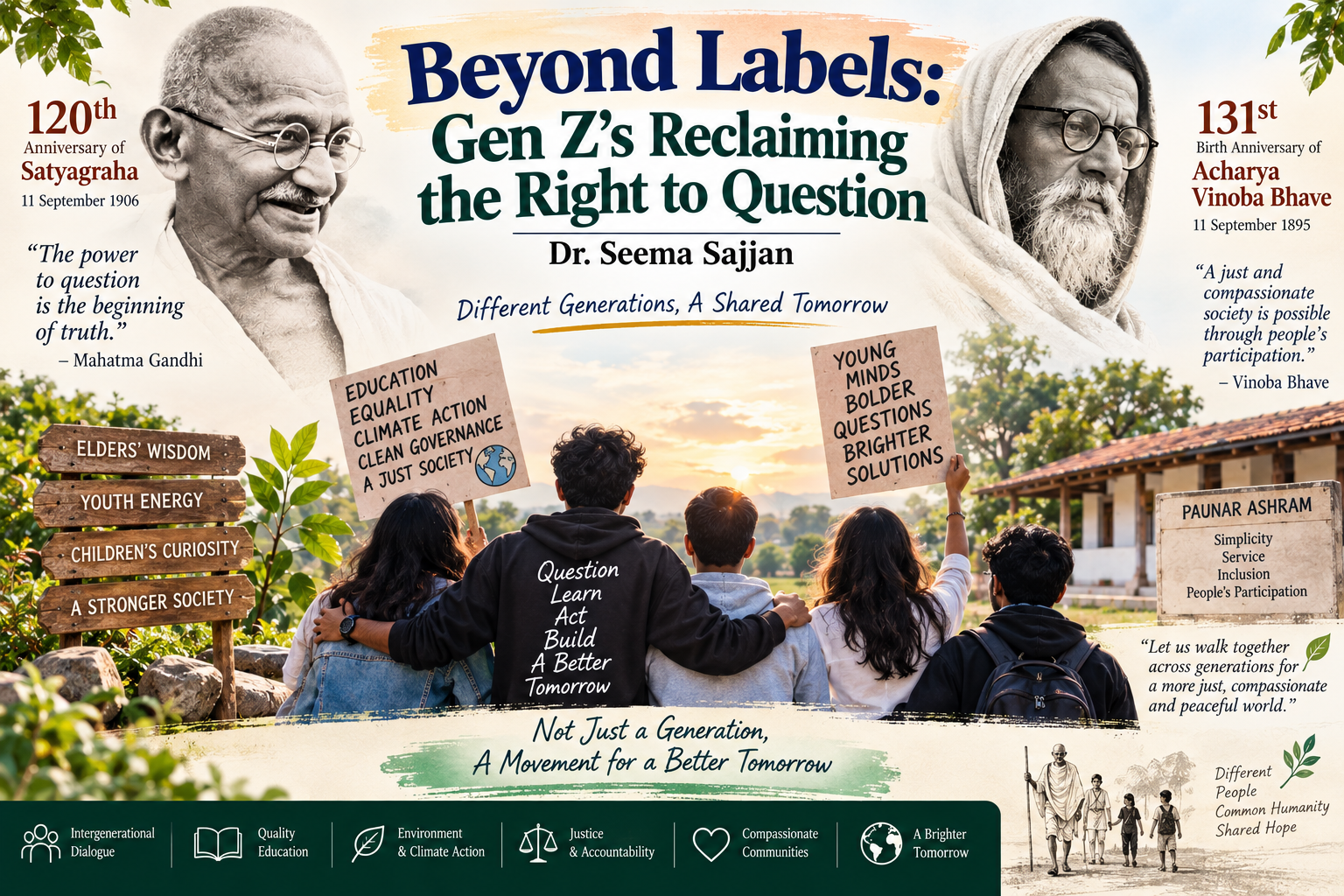
I don’t believe in sociological labels like “Gen Z” or “Alpha Gen.” I want to deconstruct these terms because society cannot be categorized by arbitrary generational names. A true community exists only when elders, adolescents, and children all come together. That is what I believe, and I am genuinely glad to be a part of this meeting. It is a momentous occasion; we are destined to meet on this very day, which marks the 120th anniversary of Satyagraha and the 131st birth anniversary of Acharya Vinoba Bhave. Meeting on this particular date feels like a fortunate turn of events for all of us.
Speaking of this “Gen Z” movement, when this movement first emerged—some even dismissed it as a fleeting phenomenon—I initially did not believe it would sustain itself for very long. I thought it would be a spontaneous, short-lived protest—like a water bubble that could burst at any moment. However, it has proven resilient and has sustained itself over the long term.
Even when the hunger strikes began, I was skeptical. As it was pointed out here, there are always disruptive factions trying to break groups apart when we are supposed to unite for the sake of the Constitution and national unity. I wondered how long they could hold on.
However, the protest on July 20th turned out to be a massive success. The youth remained calm, quiet, and highly logical in their approach, allowing them to sustain the momentum over an extended period. They refused to yield to political plots. Instead, they leveraged digital media so effectively that they managed to counter-strategize against those who were plotting against them. I deeply appreciate the insight and leadership shown by the key figures in this movement. They prove that the youth are taking the right initiatives.
It is natural for splinter groups to emerge; we have already seen another branch start and align itself with certain political parties. Yet, the core movement remains resilient. They are moving forward by addressing crucial grassroots issues, especially school education. Education is what brought them together, and it remains a vital concern for everyone. If we neglect education, I do not know where our next generation will stand. The most worrying aspect of the current generation is that they have largely forgotten how to ask questions.
Because of this, I highly appreciate that even the younger children—the school-going kids—have begun demanding their rights. They stood up for their right to education and challenged the inappropriate behaviour of their principal, demanding their removal. Milestones like these make me believe that we are moving in a progressive direction. It gives me immense hope, even though negative forces are still actively trying to break this unity.
This is exactly where seniors, elders, intellectuals, and academicians need to step in. We must handhold these youngsters and guide them onto the right path.
When I recently visited Paunar Ashram, I got goosebumps seeing the historical journey of the Bhoodan Movement. The way Vinoba Bhave traveled across India, making everyone feel completely inclusive, is extraordinary. It is hard to imagine that such an incredible visionary actually walked among us. It was a beautiful coincidence that brought me to Wardha as part of the International Fellowship on Nonviolence and Peace, where I also had the privilege of meeting Dr. Siby K. Joseph
I feel deeply fortunate to belong to this fellowship group and to have visited both Sevagram Ashram and Paunar. I was deeply inspired by Vinoba Bhave’s incredibly progressive thinking—particularly how he empowered women, building spaces where they could dedicate their lives to social work independently of traditional marital status. These structural choices were true wonders to discover.
Today is a truly auspicious day to align with this youth movement that we have initiated. I am absolutely delighted to be a part of this group. Thank you all.