
By Siby K. Joseph
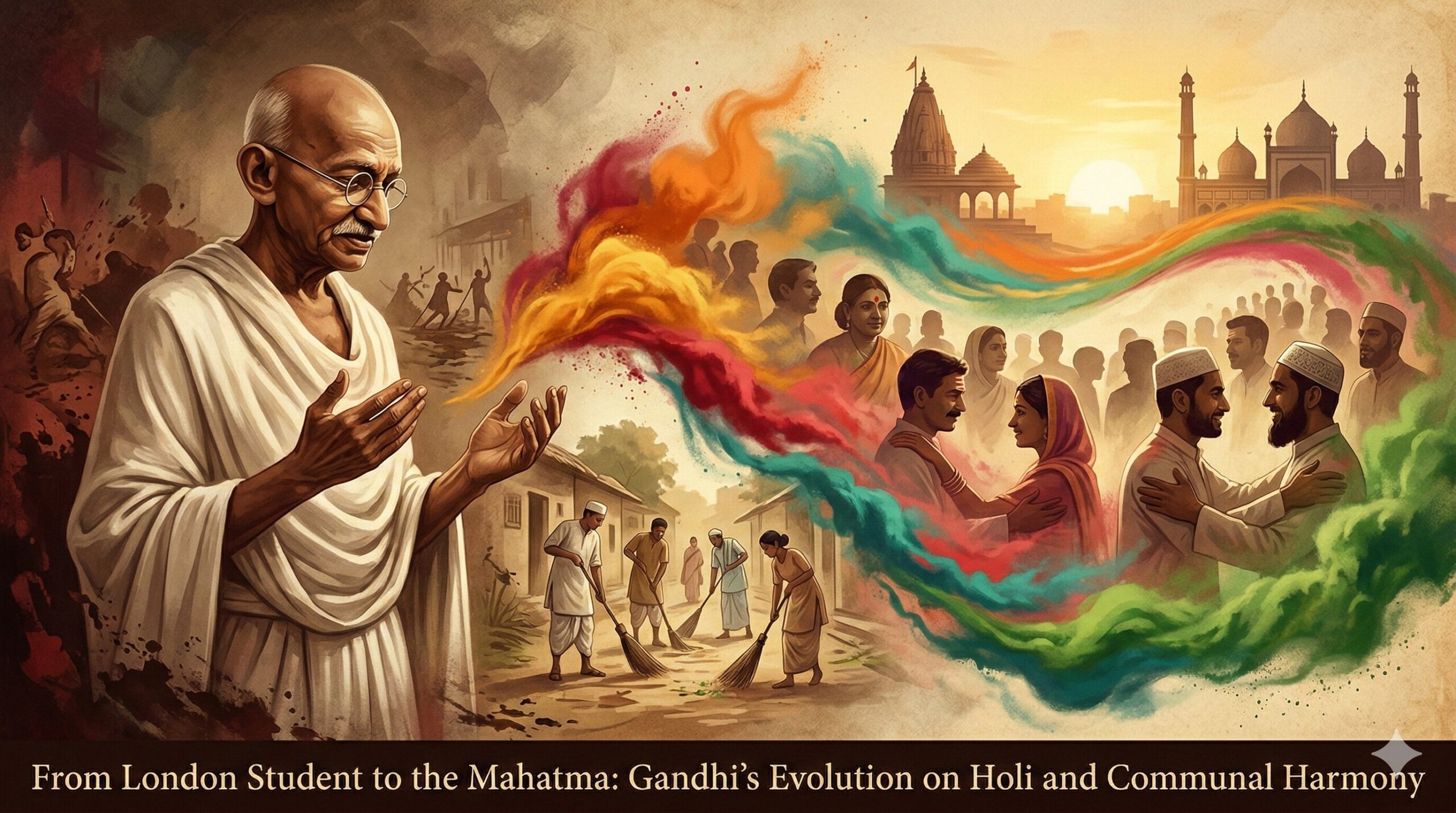
Examining Gandhi’s writings on the Holi festival, beginning from his student days in London, provides a fascinating portrait of his transformation. He evolved from a Victorian-influenced law student into a leader of the masses who utilized Hindu rituals to foster communal harmony and social cohesion. His perspectives shifted from an early critique of social etiquette in London to a revolutionary call for national purification and communal unity in India.
In April 1891, a young Mohandas Gandhi wrote an article in The Vegetarian (London), introducing the British public to Holi through a sharp analytical lens. Gandhi began his piece, titled “Some Hindu Festivals,” by grounding the reader in the sensory beauty of the spring season (Falgun). He presented the Hindu temple as a sanctuary of refinement, where the deity, Thakorji, is celebrated amidst the budding life of nature:
“The moment you enter a temple… you smell nothing but sweet flowers. Pious persons are sitting on the steps, making garlands… You enjoy soft and fragrant breezes.”
However, he sharply contrasted this serenity with the “revolting contests” found in the streets:
“Outside the temple the sight is not edifying… you here meet with nothing but obscene language,” Gandhi noted, expressing a profound distaste for the mud-slinging and harassment that characterized the festivities of the time. He lamented that, for many, it was “not considered bad taste to use obscene words during this season.”
Even at this early stage in 1891, Gandhi demonstrated his lifelong interest in social reform. He expressed the hope that the “richer and refined classes” were beginning to replace filth with “orange-coloured water” made from Kesuda flowers, signaling a shift toward more “decent” celebrations:
“It is a relief to be able to say that with the progress of education and civilisation such scenes are slowly but surely dying out.”
By the 1930s, Gandhi had moved far beyond his early distaste for the “unholy” aspects of Holi, adopting a proactive strategy for social reform and National Purification. In a 1935 issue of Harijan, he highlighted a “meritorious service” rendered by a worker in Darbhanga who, instead of participating in traditional festivities, organized thirty young men to clean the village streets. When the village elders excommunicated the group for “degrading themselves” by performing the work of scavengers—labeling them “untouchables of the worst type”—Gandhi stood firmly by the reformers. He viewed this backlash as a symptom of deep-seated “ignorance” and urged the workers to persevere regardless of personal consequences. For Gandhi, scavenging was a “precious and noble service,” a task he believed would eventually be recognized as a “service of the highest order.”
In 1938, during the Gandhi Seva Sangh meeting in Delang (Odisha), Gandhi used a hypothetical confrontation with a Muslim zamindar to illustrate that religious practice must never be surrendered out of fear. Asserting that he would “light the Holi fire right in front of” any oppressor, he urged Hindus not to “break the heads of Muslims” but rather to sacrifice their own in the pursuit of their rights. In doing so, he transformed Holi into a litmus test for non-violent resistance, demanding a greater degree of self-sacrifice.
In March 1947, against the blood-stained backdrop of pre-Partition violence, Mahatma Gandhi delivered a touching address in Patna. This was his final Holi, and he used the occasion to call for a radical “cleansing of hearts” and communal reconciliation.
Gandhi redefined the religious spirit of the festival, urging Hindus to use the day to proactively reach out to their Muslim neighbours with “overflowing love.”
“If we wish to celebrate it in a religious spirit, we must meet and greet each and every Muslim in the true spirit… reassure the Muslims that the Hindus are their brothers and that there can be no difference between us.”
He lamented how sacred slogans like Jai Hind and Vande Mataram were being weaponized to intimidate others. Gandhi expressed profound shame over reports of Muslim women being abducted and families living in terror, calling these acts a “great sin.”
“We should not terrorize each other. If at all, we should overawe each other with our love and affection… When slogans are used for a wrong purpose, their meanings too are misunderstood and they become curses instead of boons.”
Gandhi made a direct, heartfelt appeal for the release of abducted Muslim girls, offering himself as a mediator to ensure the safety of those who chose to repent.
Concluding his address, Gandhi vowed not to leave Bihar until the atmosphere of fear was replaced by sincere trust. He challenged the people to allow their “noble impulses” to overcome their “evil traits,” emphasizing that financial contributions were secondary to a genuine change of heart.
“As long as the Hindus and Muslims together do not assure me that their hearts have been cleansed… I will not leave this place… You should contribute liberally… but more than giving money, you have to cleanse your hearts.”
Gandhi’s journey of reflection on the Holi festival—from his student days in London to his final plea for communal harmony in Patna—vividly depicts the transformation of Mohandas into the Mahatma. Throughout this evolution, we see the Mahatma skillfully utilizing the religious rituals of Hinduism not as dogma, but as instruments for social reform and the bridging of hearts.
Today, as India observes both Holi and Ramzan simultaneously, his message of communal unity is more relevant than ever. At a time when our country and the world at large are held in the grip of a deepening communal divide, Gandhi’s vision of a “cleansing of hearts” serves as a vital corrective.
By reclaiming the true spiritual essence of our festivals—moving beyond outward ritual toward inner purification—we can honour his legacy. May the thoughts of the Mahatma enlighten one and all, guiding us toward a society rooted in mutual respect, non-violence, and a shared humanity.
About the Author
Dr. Siby K. Joseph is Director, Sri Jamnalal Bajaj Memorial Library and Research Centre for Gandhian Studies,
Sevagram Ashram Pratishthan, Sevagram,Wardha- 442102, Maharashtra (INDIA)
Email: directorjbmlrc@gmail.com