
The International Fellowship Program on Nonviolence and Peace (IFPNP)—a joint venture of Sevagram Ashram Pratishthan in Wardha, India; Gandhi International, France; Academic University College for Nonviolence and Human Rights (AUNOHR, Lebanon); the International Centre for Nonviolence (ICON, Durban University of Technology, South Africa); and Portland Community College (Oregon, USA)—paid tribute to Madhav Gadgil.

Professor Gadgil passed away at 11 p.m. on January 7, 2026, at Prayag Hospital in Pune after a brief illness. Dr. Siby K. Joseph, Director of the programme, informed the fellows about his passing during the online meeting of the IFPNP session held on January 8, 2026. He mentioned that Madhav Gadgil’s body was brought to his home at Spring Flower Apartment, Panchavati, Pashan, Pune, in the morning to pay respects before cremation at 4 p.m. Dr. Joseph stated that Prof. Madhav Gadgil will be ever remembered for his work on the ecological significance of the Western Ghats in India and his efforts to link scientific conservation with community rights.
As chairman of the Western Ghats Ecology Expert Panel (WGEEP), Gadgil authored the landmark report, popularly known as the Gadgil Report, in 2011. The report recommended declaring 64% of the Western Ghats region as an Ecologically Sensitive Area (ESA), which was further divided into three different Ecologically Sensitive Zones, with varying degrees of strict regulations on development activities such as mining, dam construction, and large-scale infrastructure projects. This report remains a crucial, though often controversial, document in Indian environmental policy.
He was the recipient of many national and international recognitions, including the Padma Shri (1981) and the Padma Bhushan (2006) awards by the Government of India, and the United Nations Environment Programme’s (UNEP) Champions of the Earth Lifetime Achievement Award (2024).
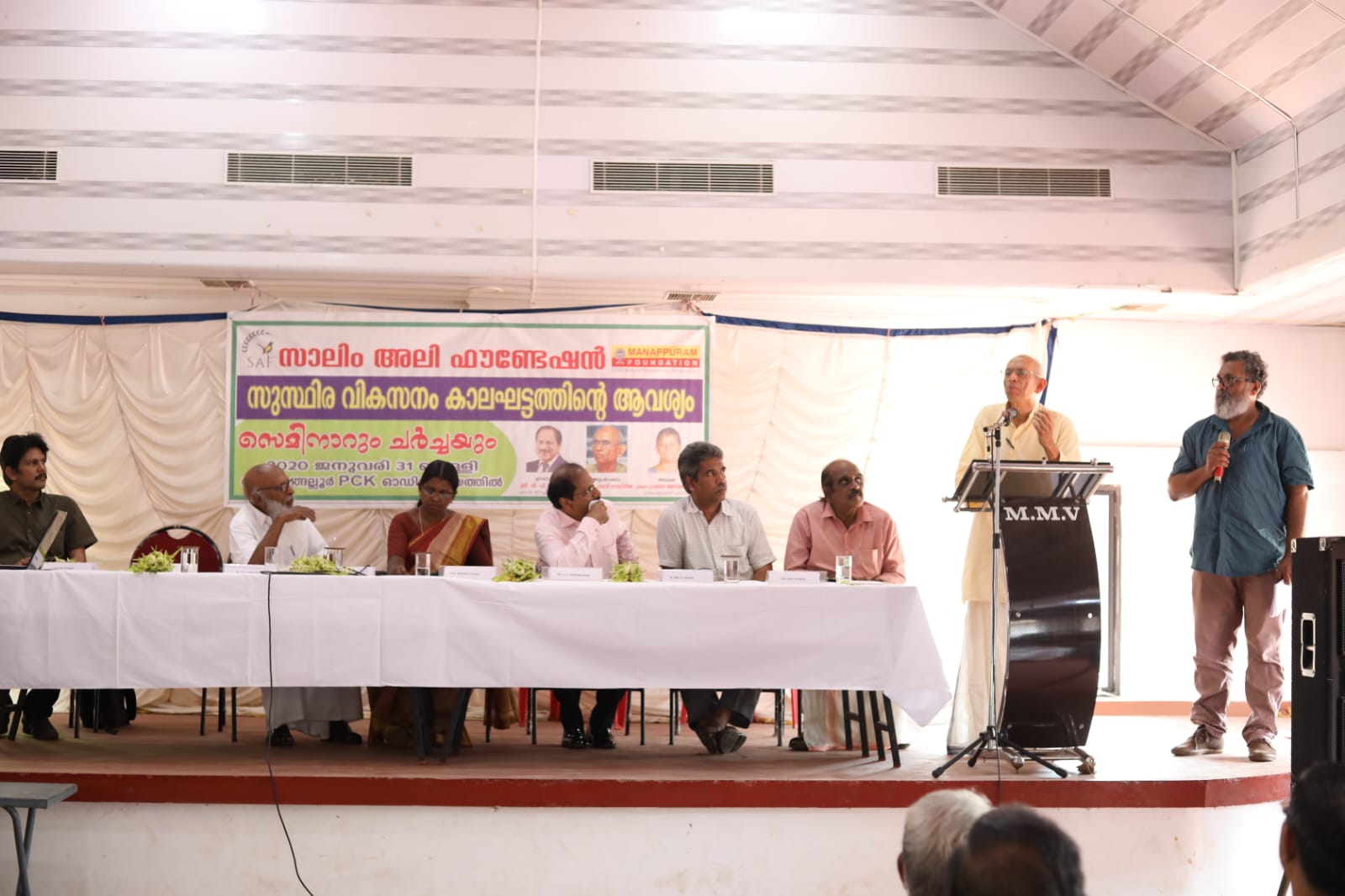
Dr. Siby Joseph recalled his meeting and stay with Prof.Gadgil at the residence of Dr. S. Vijayan, a member of the Western Ghats Ecology Expert Panel in Thrissur, Kerala, when he was invited by the Salim Ali Foundation for a seminar on Sustainable Development where Gadgil was the keynote speaker in January 2020. Through personal interaction with Professor Gadgil, he realized that Gadgil was much influenced by the thoughts of Mahatma Gandhi and Acharya Vinoba Bhave.
Dr. D. Jeevankumar, Managing Trustee of Sarvodaya International Trust and Honorary Professor at Mahatma Gandhi Rural Development and Panchayat Raj University, speaking on the occasion, said that Professor Madhav Gadgil worked in his hometown, Bangalore, while the speaker taught at Bangalore University. Prof.Gadgil served at the Indian Institute of Science (IISc) for a very long time and was truly a part of the Bangalore landscape. “Because so much important work happens at the Indian Institute of Science, I have had frequent opportunities to visit the campus over the years. Although I did not know Prof. Madhav Gadgil personally, I am a keen observer of his publications and the enormous contributions he made to environmental economics, both in theory and in practice,” Dr. Jeevankumar said. “In addition to what Dr. Siby Joseph shared, let me add two or three points to provide a more comprehensive picture of this scholar-scientist’s legacy.”
“First, he founded the Centre for Ecological Sciences at the Indian Institute of Science in Bangalore. Much of the work we associate with Prof. Gadgil can be traced back to this centre. Among his notable achievements, the establishment of India’s first biosphere reserve stands out. In 1986, the Nilgiri Biosphere Reserve was established in the Western Ghats; the credit for this milestone goes to him. Another significant contribution was his key role in drafting India’s Biological Diversity Act. This is a notable piece of legislation that aims to conserve and sustainably use India’s biodiversity. While the act may have limitations and its practical implementation by governments is often debated, his role in shaping it was instrumental.”
“A third reason I remember Prof. Gadgil, beyond his impressive scholarly writings, is his commitment to community-led conservation. He strongly believed that local communities must play a central role in the management of natural resources. In this regard, he often stood in opposition to the state—specifically the Indian Forest Service—which generally maintains that professional foresters know better than local communities how to preserve the environment. Prof. Gadgil disagreed with this mainstream thinking. He argued that the people who have lived in these forests and the Western Ghats for hundreds, or even thousands, of years possess a rich, indigenous knowledge of how biodiversity should be preserved. By championing these community-led efforts, he left a lasting impact.”
Dr. Michael Sonnleitner, former Professor and Trustee of Portland Community College, Oregon, USA, who chaired the session paying tributes to Madhav Gadgil, commented, “I would only comment that, in my view—and I believe Gandhi and many others would agree—no life is ever truly lost. People like Professor Gadgil live on by inspiring us to continue their work. It is not merely a matter of awards and accomplishments; it is a matter of how a life is lived. On a related note, I am saddened today by the death of a 37-year-old woman in Minneapolis, Minnesota, yesterday.”
All IFPNP fellows from different parts of the world observed silence, paying tribute to Madhav Gadgil.