

The short-term winter camp on Gandhian Thought for university and college students from across India has been a regular feature of the Sevagram Ashram Pratishthan at Sevagram , Wardha, Maharashtra, since the establishment of the Library and Research Centre for Gandhian Studies during the 2021-22 academic year. The camp provides a unique opportunity for students to understand Gandhi’s life, philosophy, and methods of action within the historic setting of Sevagram Ashram. This site served as Mahatma Gandhi’s home from April 30, 1936, until the final period of his life, which ended with his martyrdom in New Delhi on January 30, 1948. Mahatma Gandhi spent one decade living at this ashram before departing on his peace mission in August 1946. The core objective of this course is to acquaint students with Gandhi’s work and his enduring relevance for posterity. This five-day residential programme offers an immersive experience for students to analyze the depth of Gandhian values and their application to humanity’s current predicaments through a blend of prayer, yoga, meditation, shramdan (voluntary labor), peace games, academic sessions, field visits, group discussions, and cultural events.
The short-term winter camp on Gandhian Thought for the 2025–26 academic year was held at the Sevagram Ashram premises from December 23 to 27, 2025. Participants from various Indian states arrived at the ashram on December 22, spending nearly a week there over Christmas. Students ranging from undergraduates to postdoctoral fellows, representing central, state and private universities across the country, and two faculty members participated in the course. The more than fifty male and female attendees came from a wide variety of academic disciplines and hailed from Kerala, Tamil Nadu, Puducherry, Karnataka, Maharashtra, Madhya Pradesh, Uttar Pradesh, Bihar, Delhi, Odisha, Gujarat, and Rajasthan.


The winter camp was formally inaugurated on December 23 at the Seminar Hall of the Sri Jamnalal Bajaj Memorial Library and Research Centre for Gandhian Studies, Sevagram Ashram Pratishthan. The session opened with a brief introduction by Dr. Siby K. Joseph, a Gandhian scholar and Director of the Research Centre.The keynote address was delivered by Dr. Ulhas Jajoo, a renowned medical practitioner and former Professor and Head of the Department of Medicine at the Mahatma Gandhi Institute of Medical Sciences (MGIMS), Sevagram. Dr. Jajoo, whom Pulitzer Prize winner Joseph Lelyveld once described by saying “Gandhi lives in Dr. Jajoo…” is a co-founder of the Medical Friend Circle. His lifelong commitment to Gandhian values and rural upliftment is demonstrated through his successful health insurance schemes and village development projects modelled on Sarvodaya principles. In his inaugural address he made an exploration of the contemporary relevance of Gandhi’s experiments and its significance for younger generations in changed times. During the session, Dr. Jajoo made an in-depth discussion on “how we transcend boundaries.” In his analysis, he offered a nuanced distinction between buddhi (intellectual labor) and shram (physical labour), which remains a cornerstone of Gandhi’s philosophy of Sarvodaya. This distinction challenges the traditional hierarchy that often values mental work over manual effort. By emphasizing shram, Gandhi sought to restore the dignity of labour and promote economic self-reliance. This discussion focused on how bridging the gap between the two can lead to a more equitable society, encouraging students to integrate practical, physical service with their academic pursuits. The personal reflections from Dr. Jajoo’s own upbringing in a Gandhian family was eye opening for the students. Shri Vijay Tambe who presided over the inaugural session summed up the key learning from Prof. Jajoo’s presentation. It was followed by a discussion on Charkha Economy and the philosophy of Khadi. The session ended with concluding remarks from Shri Barun Mitra an activist and thinker and founder director of the Liberty Institute, New Delhi and recipient of Julian L. Simon Award for his contribution in environmental policy debates from the Competitive Enterprise Institute.
To introduce Gandhi’s life and work spanning several decades, the biographical film Mahatma: Life of Gandhi was screened for the participants on the very first day of the camp. In the evening, prior to the interreligious prayer at 6:00 p.m.—a tradition maintained since Gandhi’s time—participants were taken on a guided tour of Sevagram Ashram. This tour highlighted the site’s historical significance as a witness to key events of the freedom struggle and allowed students to immerse themselves in the simplicity and tranquillity of Gandhi’s former residence. Participating in the evening prayer on the open ground—without electricity and chanting texts from various religions—was an enriching experience for the students. This practice, conducted just as it was in Gandhi’s time, offered a profound sense of spiritual unity and simplicity. The day ended with screening and brief discussion regarding the impact of the biographical film on the participants’ understanding of his legacy.
The major themes discussed over the five days included: the centrality of Truth and nonviolence in Gandhian thought; misconceptions about Gandhi; the significance of Gandhi’s approach to religion in contemporary society; and the transition from colonialism to nationalism through the perspective of Swaraj. Additional topics covered environmentalism (Think Globally, Act Locally), the intersection of Gandhi and science, biodiversity, and sustainable farming. The sessions also explored globalisation, Artificial Intelligence, entrepreneurship, modern relationships, conflict resolution, development paradigms, sustainability, and the legacy of Gandhi’s Sevagram Ashram. These sessions helped participants contextualize Gandhi within contemporary challenges, demonstrating how to apply Gandhian principles to overcome the modern riddles facing humanity. The distinguished faculty consist of Prof. Ulhas Jajoo, Shri Barun Mitra, Shri Vijay Tambe, Dr. Ravindra RP, Shri Sajal Kulkarni, Prof. John Chelladurai, Shri Atul Upadhyaya, Mrs. Prajakta Upadhyaya, Prof.Jeevan Kumar, Dr.Manjushri Landge Dr. Siby K. joseph and others


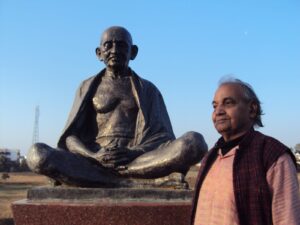
On December 24, following the morning session, the remainder of the day was devoted to field visits to historic sites in Wardha associated with Mahatma Gandhi. The first location visited was the Charkha Griha of the Sevagram Ashram Pratishthan. There, they viewed statues of Mahatma Gandhi and Acharya Vinoba Bhave, as well as the world’s largest charkha (spinning wheel) installed on the premises. Students enthusiastically took photos of the statues, which were uniquely crafted from automobile scrap metal. Next, they visited Gita Mandir, the final resting place of Jamnalal Bajaj. This structure features 700 shlokas from the 18 chapters of the Gita inscribed on rock slabs brought from all corners of the country, symbolizing national integration. The structure’s design uniquely incorporates the shapes of a cow and a spinning wheel. The group also viewed exhibitions dedicated to Jamnalal Bajaj and Vinoba Bhave on the premises before visiting the Vishwa Shanti Stupa (World Peace Pagoda). This monument was built to commemorate the historic meeting between Mahatma Gandhi and Fujii Guruji, the founder of the Nipponzan Myohoji sect. Furthermore, they observed the entrance of the All-India Village Industries Association (AIVIA) and Goras Bhandar at Maganwadi, Wardha. They also saw various Khadi and village industry displays and the new Gandhi exhibition at Magan Sangrahalaya , a museum of rural technology. The final leg of the journey took them to Acharya Vinoba Bhave’s Paramdham Ashram at Paunar. Before departing, the students visited the banks of the Dham River, a significant site where the ashes of both Mahatma Gandhi and Vinoba Bhave were immersed. On Christmas Eve night, the group shared the joy of the season with a celebration featuring a cake-cutting ceremony and a cultural event. During the programme, students showcased their talents through performances that highlighted the rich variety and diversity of different languages and cultures.
Each day of the camp began with morning prayers followed by yoga and meditation, and concluded with a community prayer at the ashram in the evening. During the morning sessions, students were divided into small groups for shramdaan activities, such as sanitation, cleaning classrooms, watering plants, gardening, and collecting leaves for composting. The students embraced these tasks with great love and enthusiasm, pouring their hearts and energy into the work. It was an unforgettable experience that helped foster deep friendships, unity, and a sense of oneness.
In the evening, the students were divided into small groups for discussions. Each group selected a topic of their choice and reported a summary of their discussion back to the larger group. They explored a variety of themes, including greed versus need, economic equality, gender justice, and reservation policies. These small-group sessions provided a space for students to air their views and arrive at thoughtful conclusions through shared deliberation.
The students participated in peace games, which helped them realize how to resolve conflicts, maintain relationships, and manage group dynamics—all important elements for personality development and leadership skills. During the camp, the students and faculty also went on a peace walk to understand how the five elements that constitute our bodies are interconnected with the universe and all living things within it. This exercise fostered a worldview that emphasizes the interconnectedness and unity of all beings, highlighting the significance of our relational world.
The camp concluded on December 27, 2025, with a valedictory session. During this session, participants shared their experiences of the course and collectively evaluated the program. Many students spoke about the transformative nature of their days spent at the ashram, explaining how the experience helped them rethink their ways of life and view the world from an entirely new perspective. The valedictory session was attended by the course’s distinguished faculty, including Prof. Jeevan Kumar, Managing Trustee of the Sarvodaya International Trust; Prof. John Chelladurai, Dean of the Faculty of Interdisciplinary Studies at Mahatma Gandhi Mission University; Dr. Manjushri Landge, from the Department of Women and Gender Studies at MGM University; Shri Vijay Tambey, Secretary of the Sevagram Ashram Pratishthan; and Dr. Siby K. Joseph, Director of the Library and Research Centre, among others.
The camp was efficiently coordinated by Hari Sonune of MGM University and Dr. Prince Singh of Mahatma Gandhi Antarrashtriya Hindi Vishwavidyalaya (MGAHV), Wardha. The students were felicitated with certificates of appreciation. The Director of the Sri Jamnalal Bajaj Memorial Library and Research Centre was instrumental in directing the camp on behalf of the Sevagram Ashram Pratishthan. Participants left the Sevagram Ashram with a sense of satisfaction and mutual bonding, determined to transform their lives by following Gandhian ethics and values. They departed with a nuanced understanding of how to reconcile modern contradictions through the lens of truth and non-violence.
Photo credits: Participants of the Camp and special thanks to Gazal P. Reji for the kind help and coordination in the preparation of report