
Dr. Siby K. Joseph
Distinguished Guest Speaker Kathy Kelly, Prof. Michael Sonnleitner, Prof. John Chelladurai, Fellowship Program Alumni, fellow partners, associates, and friends:
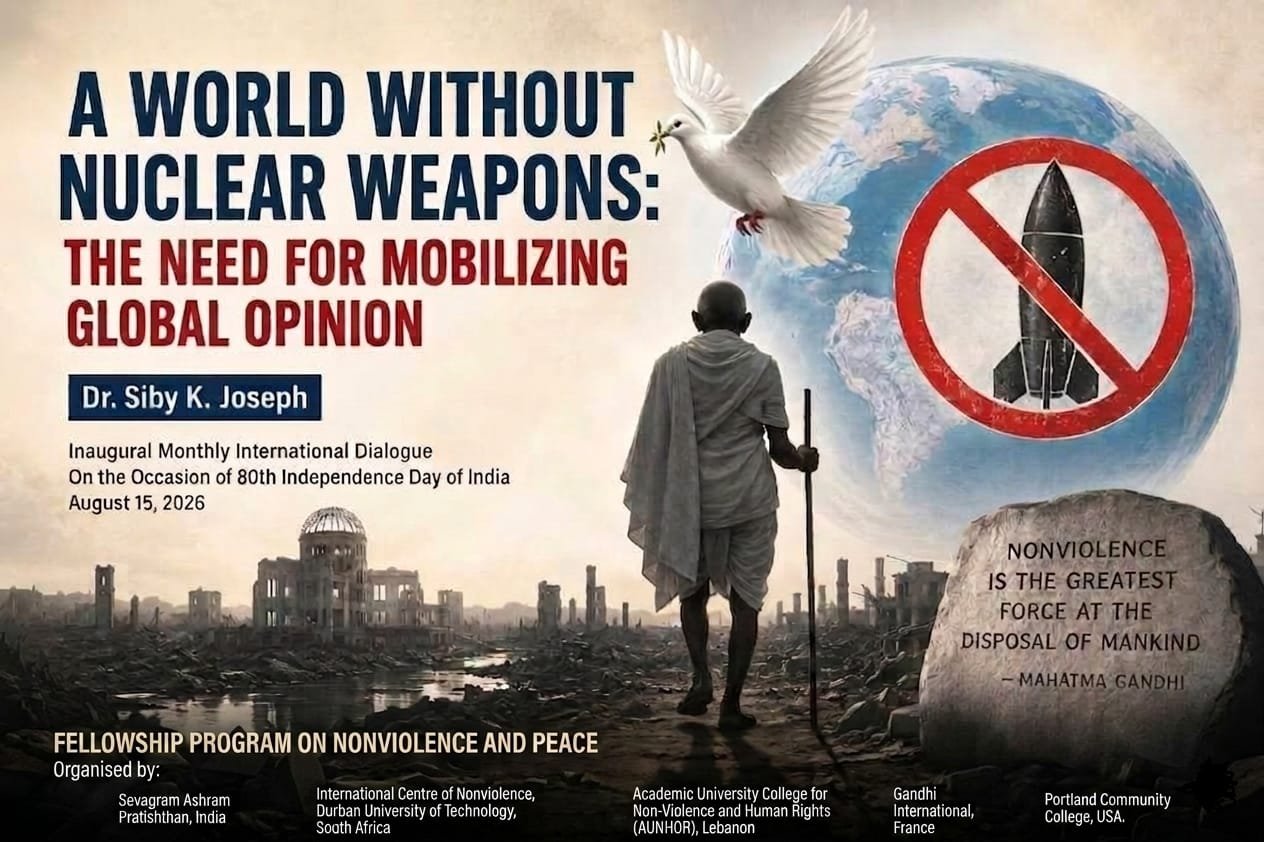
As India marks its 80th Independence Day today on August 15, 2026, I wish all our Indian friends a Happy Independence Day. Today, we commemorate 79 years of freedom from British rule, which began in 1947. This milestone closely follows early August commemorations marking over 80 years since the tragic atomic bombings of Hiroshima on August 6 and Nagasaki on August 9, 1945. Even after more than eight decades, the threat of weapons of mass destruction—especially nuclear ones—remains over our heads like the sword of Damocles.
Today, we are commencing a vital new initiative: a monthly International Dialogue as part of our Fellowship Program. It is a venture of Sevagram Ashram Pratishthan (India), in association with Gandhi International (France), AUNOHR (Lebanon), ICON-DUT (South Africa), and Portland Community College (USA).
Today we discuss the threat of nuclear weapons to world peace, focusing on Hiroshima to the present day in this international dialogue. As I am talking from the historic premises of Mahatma Gandhi’s Sevagram Ashram, the moot question before us is whether the atomic bomb can be met with his method of nonviolence.
Therefore, it is appropriate to look at how Gandhi, the apostle of nonviolence, viewed such a scenario.
During his interview with American journalist Margaret Bourke-White just hours before his assassination on January 30, 1948, Gandhi reiterated that even the atomic bomb must be faced with nonviolence. Through the atomic bomb, mankind held the key to ultimate destruction; Gandhi placed a different path before us. Here in our midst are our distinguished personalities from America, Kathy Kelly and Prof. Michael Sonnleitner. It is interesting to note that when the American journalist asked Gandhi whether America should stop manufacturing the atomic bomb, he replied without hesitation, “Certainly America should stop.”
Gandhi’s stand was clear: even the mighty powers should stop manufacturing nuclear weapons. If Gandhi were alive today, he would have asked to stop the mad rush of nuclear-weapon states threatening world peace. It was his firm conviction that bad means could never bring about good ends. It remains an undeniable fact that a peaceful world cannot be built on the threat mechanism of weapons of mass destruction. It is my firm conviction that the theory of nuclear deterrence is a misnomer.
In the context of recent global conflicts, including the escalating geopolitical crises involving Israel, America, and Iran, I wrote about Gandhi’s way and what our approach should be, referring to Gandhi’s last interview. I think it would be appropriate to refer here again.
When Bourke-White probed Gandhi on the “dreadful problem” of how to confront such a weapon, Gandhi answered with profound sincerity: “I would meet it by prayerful action.” He explained that he would not hide in shelters or go underground, but would “go out and face the pilot so he will see I have not the face of evil against him.” He acknowledged that a pilot might not see a face from such a great height; yet, Gandhi maintained that the “longing in our hearts that he should not come to harm would reach up to him, and his eyes would be opened.”
Reflecting on the tragedy of Hiroshima, he lamented that if the victims had died with that prayer in their hearts, the war would not have ended so disgracefully. He warned that in such conflicts, it is a question of “whether the victors are really victors or victims… of our own lust and omission.” He further added, “The world is not at peace. It is still more dreadful than before.”
The dreadful state of global peace has heightened with the passage of eight decades after Hiroshima and Nagasaki. At that time, only one country—America—possessed nuclear weapons; now nine countries possess nuclear weapon warheads ever ready for nuclear warfare. Now we are living in an age dominated by artificial intelligence, and its application in warfare poses an existential threat to the very survival of humanity.
As of today, these nine countries possess 12,187 nuclear warheads globally, distributed as follows:
- Russia: 5,459
- USA: 5,277
- China: 600
- France: 290
- UK: 225
- India: 180
- Pakistan: 170
- Israel: 90
- North Korea: 50
Additionally, six non-nuclear nations host nuclear weapons on their soil: Italy (35), Turkiye (20), Belgium (15), Germany (15), the Netherlands (15), and Belarus (?).
While these nine states and their partners advocate for nuclear arsenals, the rest of the world strongly rejects them. This global opposition is evident from the passage of the Treaty on the Prohibition of Nuclear Weapons (TPNW) in July 2017, where 122 countries voted in its favour and only one opposed it. The treaty officially came into force in January 2021. Currently, there are 75 states parties alongside an additional 25 signatories. This means more than half of the United Nations members stand firmly against nuclear weapons, even though the nuclear-armed states have not yet joined. The TPNW strictly outlaws developing, testing, producing, possessing, or threatening to use nuclear weapons.
It is the duty of all peace-loving people to work toward the total elimination of weapons of mass destruction. We must extend our full support to non-nuclear nations and grassroots organizations, such as the International Campaign to Abolish Nuclear Weapons (ICAN), in their tireless efforts to achieve a world without war and violence. I am confident that this webinar will be an enriching experience, helping us understand this critical problem from the right perspective and succeeding in building public opinion in favor of total disarmament.
Acknowledgement
This is the text of the Address delivered by Dr. Siby K. Joseph, Director of International Fellowship Program on Nonviolence and Peace, on August 15, 2026, during the inaugural monthly International Dialogue.