
Global Gandhi – Youth for Truth Dialogue
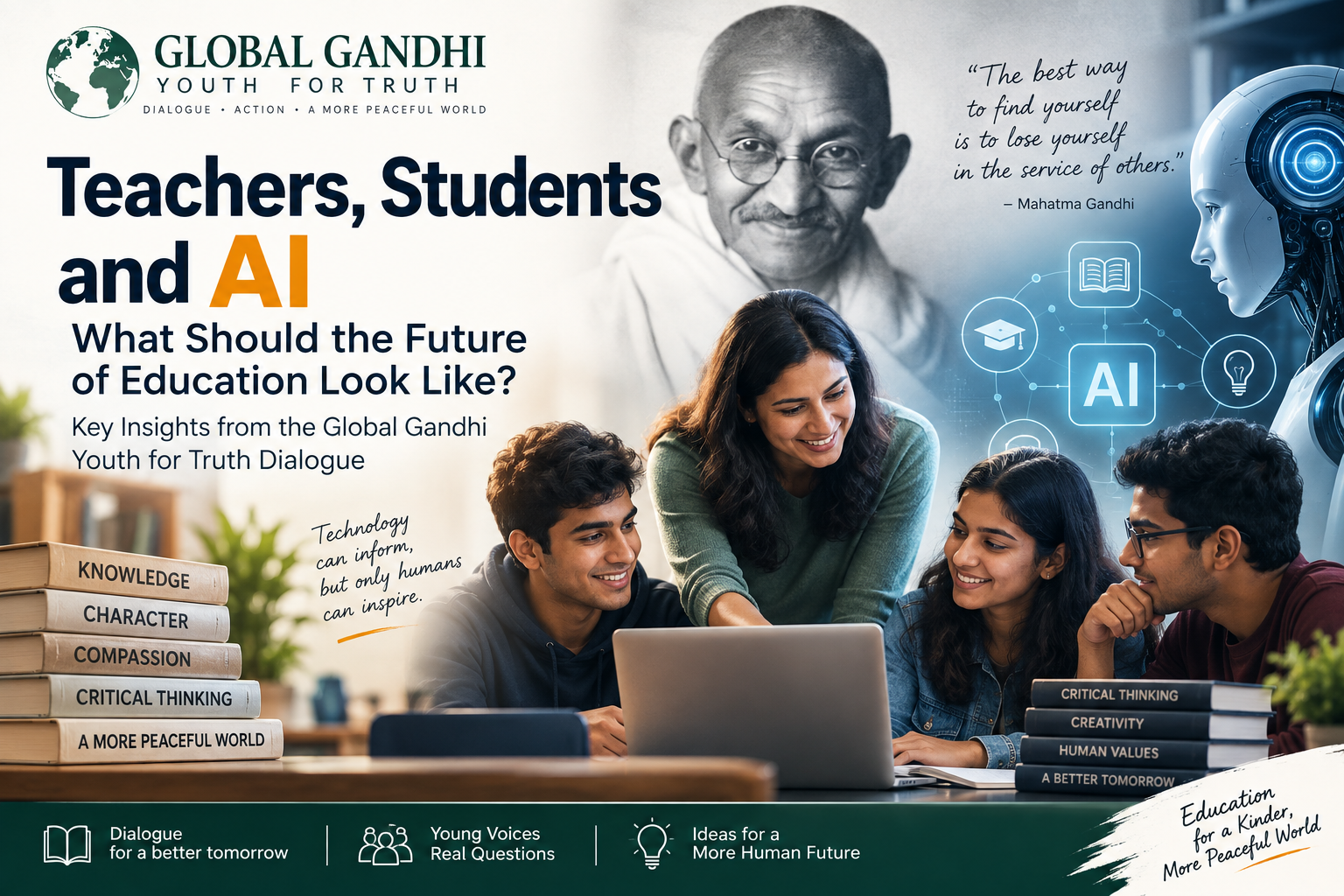
Teachers, Students and AI: What Should the Future of Education Look Like?
The latest Global Gandhi – Youth for Truth dialogue brought together educators, students, young people and technology enthusiasts for an important conversation on one of the most pressing questions facing education today:
How should education evolve in an age of Artificial Intelligence?
The dialogue explored the rapidly changing relationship between teachers, students, technology and knowledge, while asking a deeper question: if AI can provide information and answers within seconds, what should education continue to teach that is uniquely human?
Education Beyond Information
The main address was delivered by Professor Raisur Rahman, Chair and Associate Professor of History at Wake Forest University, who emphasised that education should not be reduced to the simple transfer of information.
As AI becomes increasingly capable of searching, processing and presenting information, the purpose of education must move towards character formation, critical thinking, intellectual integrity and sound judgment.
Professor Rahman highlighted the continuing importance of teachers as human mentors and moral examples. While AI can assist students with information and certain academic tasks, it cannot replace the human dimensions of education — including guidance, values, relationships and the development of judgment.
He also encouraged educators to focus on teaching students the bigger picture, comparative frameworks and important concepts, rather than concentrating only on factual information that technology can increasingly provide.
The Risk of Over-Reliance on AI
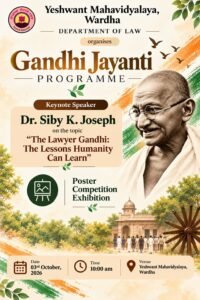
Dr. Sibi K. Joseph, a founding member of Global Gandhi and Director of the Sri Jamnalal Bajaj Memorial Library and Research Centre for Gandhian Studies at Sevagram Ashram, Wardha, also shared important reflections on the growing use of AI.
He highlighted the dangers of becoming overly dependent on technology, particularly the possibility that students may gradually lose the habit of thinking independently, questioning information and developing their own ideas.
The discussion emphasised that AI should remain a tool for learning, rather than becoming a substitute for human thought, creativity and judgment.
Teachers as Mentors and Coaches
Vishal Shivhare, a core founding member of Global Gandhi with strong knowledge of technology and Artificial Intelligence, contributed his perspective on the changing role of educators.
The discussion suggested that teachers of the future may increasingly serve as mentors, guides and coaches, helping students navigate information, evaluate AI-generated content and develop the ability to think for themselves.
The challenge, therefore, is not whether students should use AI, but how they should use it responsibly and meaningfully.
Questions from the Participants
The Q&A session brought forward a range of important questions surrounding the future of AI and education.
Participants explored:
- The limitations of Artificial Intelligence.
- The role of AI in literature and creative work.
- The potential risks associated with the development of AI.
- How students can use AI without losing their creativity.
- How education can preserve independent and critical thinking.
- How teachers can help students develop judgment in an environment where information is increasingly accessible.
These questions reinforced an important message from the dialogue: access to information is not the same as understanding, and receiving an answer is not the same as learning how to think.
Education and the Human Being
The conversation also connected the future of education with a broader understanding of what education is meant to achieve.
In the spirit of Gandhian thought, the dialogue raised the question of whether education should focus not only on what a student knows, but also on what kind of person that student becomes.
As technology continues to develop, qualities such as creativity, curiosity, empathy, responsibility, critical thinking and intellectual independence remain essential.
The future of education, therefore, may not be about choosing between human teachers and Artificial Intelligence. Instead, it may be about finding the right balance — using technology where it can help, while ensuring that human judgment, creativity and values remain at the centre of education.
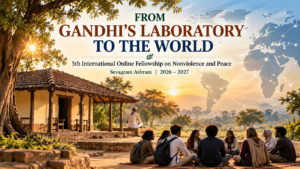
5th International Fellowship Program on Nonviolence and Peace
During the dialogue, Dr. Sibi K. Joseph also introduced the 5th International Fellowship Program on Nonviolence and Peace, an international programme focused on nonviolence, peace, critical thinking, conflict transformation and community engagement.
Participants interested in the fellowship were encouraged to explore the programme and application details through:
Website: nonvpa.in
Email: peace.nonviolence2022@gmail.com
WhatsApp: +91 98223 8341
Continuing the Conversation
The Global Gandhi – Youth for Truth dialogue concluded with thanks to Professor Raisur Rahman, Dr. Sibi K. Joseph, Vishal Shivhare, and all the participants who contributed their questions, reflections and ideas.
The discussion leaves us with a question that is likely to become increasingly important in the years ahead:
If Artificial Intelligence can change the way we access knowledge, how should we change the way we learn, teach and become human?
The conversation does not end with technology. It begins with the responsibility of ensuring that technology serves education — and that education continues to serve humanity.
Global Gandhi – Youth for Truth remains committed to creating spaces for meaningful dialogue, critical thinking and young voices on the questions shaping our shared future.