
Dr. Siby K. Joseph
Director, Sri Jamnalal Bajaj Memorial Library and Research Centre for Gandhian Studies, Sevagram Ashram Pratishthan, Wardha-442102, Maharashtra (INDIA)
Email: directorjbmlrc@gmail.com
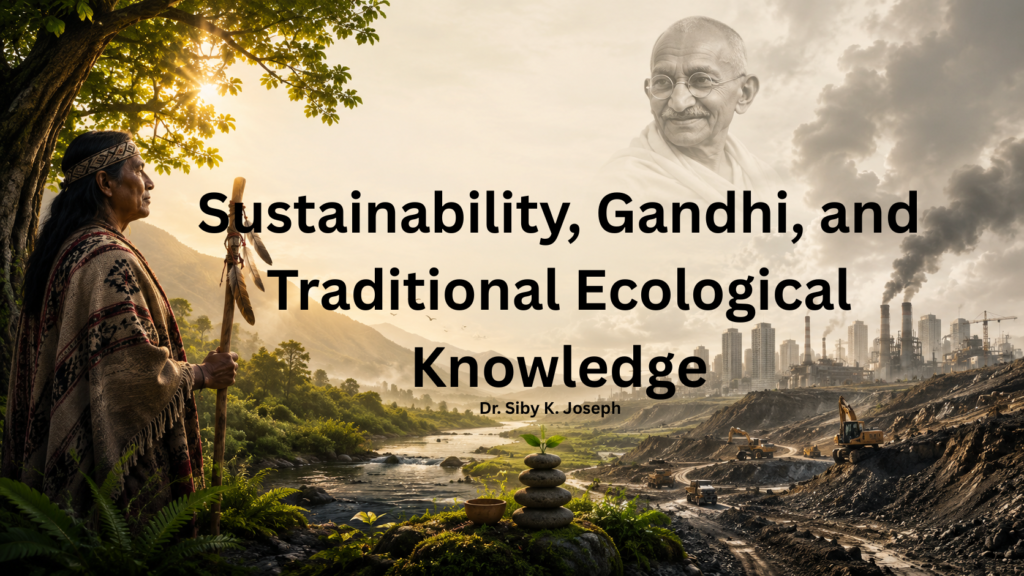
An Indigenous Challenge to Modern Metrics
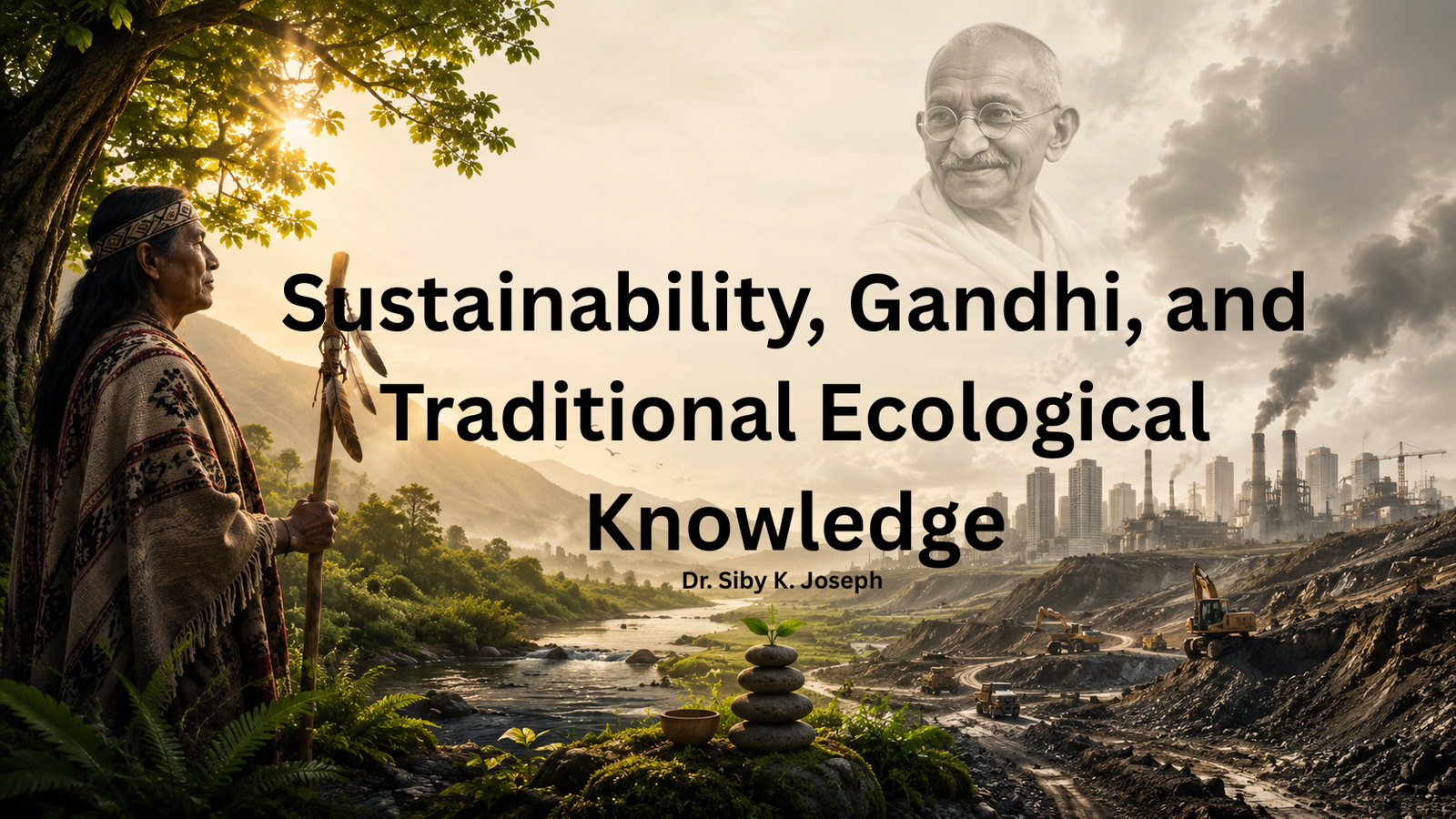
On January 30, 2026, while addressing the participants of the International Fellowship Programme on Nonviolence and Peace from the Library and Research Centre of Mahatma Gandhi’s Sevagram Ashram, Louis Campana—the founding President of Gandhi International—shared his experience of a meeting with Nobel Peace Prize laureate Adolfo Pérez Esquivel and a Guarani chief from South America, which happened some years ago. The recollection of these discussions challenged the participants’ vision of development and sustainability.
Campana narrated: When the Guarani chief was asked what the word “development” meant to him, his response was striking: the word simply did not exist in his language. Instead, the chief offered a different metric for collective well-being:
“In our world, we have a word: balance. This means balance with nature, the environment, the cosmos, God, the unknown forces, others, and ourselves.”
Contemplating on it, Campana said: “When this balance is broken, violence begins. These people have never damaged their environment. Before farming, they ask the earth for forgiveness for digging into her. They live beyond what we call ‘sustainability.’”
The Historical Context of Sustainability
Therefore, it is interesting to observe how the concepts of sustainability and sustainable development entered mainstream discourse. These new terms emerged in response to the global environmental crisis humanity faced, which were a direct consequence of industrialization and the aggressive economic growth of capitalist nations.
Environmental issues first received widespread global attention in the 1970s. As a result, the first United Nations Conference on the Human Environment (1972) was held in Stockholm, Sweden. This landmark event brought the environment to the centre stage of the global agenda and later led to the establishment of the United Nations Environment Programme (UNEP).
In 1983, the UN General Assembly set up the World Commission on Environment and Development, popularly known as the Brundtland Commission. Its primary aim was to link environmental issues to the findings of the 1980 Brandt Report on North-South relations. The Brundtland Report, entitled Our Common Future and published in 1987, firmly established the link between the environment and the economy, coining the new term “sustainable development.”
The Corporate Blueprint of the Brundtland Report
The Report inter alia said:
“Humanity has the ability to make development sustainable to ensure that it meets the needs of the present without compromising the ability of future generations to meet their own needs. The concept of sustainable development does imply limits — not absolute limits but limitations imposed by the present state of technology and social organization on environmental resources and by the ability of the biosphere to absorb the effects of human activities. But technology and social organization can be both managed and improved to make way for a new era of economic growth. …, but sustainable development requires meeting the basic needs of all and extending to all the opportunity to fulfil their aspirations for a better life … Sustainable global development requires that those who are more affluent adopt lifestyles within the planet’s ecological means – in their use of energy, for example. Further, rapidly growing populations can increase the pressure on resources and slow any rise in living standards; thus sustainable development can only be pursued if population size and growth are in harmony with the changing productive potential of the ecosystem. .. sustainable development is not a fixed state of harmony, but rather a process of change in which the exploitation of resources, the direction of investments, the orientation of technological development, and institutional change are made consistent with future as well as present needs.”
The Myth of Growth-Driven Sustainability
Thus, it is clear that the Brundtland Report is ultimately an assertion of the myth of growth-driven sustainability. This is very evident when it claims that “technology and social organization can be both managed and improved to make way for a new era of economic growth.” This statement is inherently contradictory; this proposed “new era” relies entirely on unlimited material consumption—the core tenet of modern industrial development. Rather than challenging the status quo, it seeks to rescue global capitalism through clever technological engineering.
Furthermore, the framework completely fails to respect the laws of nature or enforce absolute planetary limits to prevent further ecological damage. Instead, the report asserts that boundaries are merely “limitations imposed by the present state of technology and social organization.” This perspective is extremely dangerous because it treats nature’s limits as flexible variables. Under this logic, the modern solution to an environmental crisis is never to halt exploitation, but rather to hide it by upgrading technology to extract resources more efficiently.
Consequently, this entire concept remains fundamentally anthropocentric and approaches ecological survival from a purely managerial point of view. Its ultimate goal is simply to find ways to “absorb the effects of human activities,” completely disregarding the intrinsic value and balance of the biosphere and its fragile ecosystems.
The Cosmological Vision of Advaita
The modern framework of sustainable development and what this indigenous leader described are polar opposites—like the North and South Poles. However, one can see a striking balance between this indigenous interpretation of development and the interconnected, relational worldview of Mahatma Gandhi. This worldview is based on the concept of Advaita (non-duality). He wrote:
“I do not believe that an individual may gain spiritually and those that surround him suffer. I believe in Advaita. I believe in the essential unity of man and, for that matter, of all that lives. Therefore, I believe that if one man gains spiritually, the whole world gains with him and, if one man falls, the whole world falls to that extent.”
He strongly believed in the unity and oneness of all life and its interconnectedness. This relational worldview is not anthropocentric; it is equally applicable to animal and plant life. Gandhian environmental ethics stems from this worldview, which can be considered the strong foundation of a deep environmental philosophy.
Gandhi’s Impact on Deep Ecology
Many environmentalists have duly acknowledged their debt to Gandhi in formulating new concepts relating to ecology or understanding environmental issues from a proper perspective. It is interesting to note that Arne Naess, who coined the term ‘deep ecology,’ has acknowledged his indebtedness to Gandhi in the formulation of this term. Gandhi’s life and actions were the direct result of a deep eco-consciousness.
Living Traditional Ecological Knowledge: Aparigraha and Yajna
Many concepts that Gandhi propounded stem from this eco-consciousness, especially his ideal of Aparigraha (non-possession). According to Gandhi, “A seeker of the Truth, a follower of the law of Love cannot hold anything against tomorrow.” Gandhi gave a nuanced meaning to the verse in the Isha Upanishad—tena tyaktena bhunjitha (enjoy the wealth by renouncing it). He said:
“Earn your crores by all means but understand that your wealth is not yours; it belongs to the people. Take what you require for your legitimate needs and use the remainder for society.”
This philosophy calls for the application of the doctrine of trusteeship, dictating that everyone should use the resources of nature with a sense of Aparigraha for the common welfare of the people.
Similarly, his insistence on the performance of Yajna (sacrifice) was an attempt to return whatever one takes from nature, or a fulfilment of the debts created as a result of our very existence and living. He explains his concept of Yajna as follows:
“Yajna means an act directed to the welfare of others, done without desiring any return for it, whether of a temporal or spiritual nature. ‘Act’ here must be taken in the widest sense, and includes thoughts and words as well as deeds. ‘Others’ embraces not only humanity, but all life….. Yajna having come to us with our birth, we are debtors all our lives, and thus for ever bound to serve the universe.”
What Gandhi was drawing upon were ancient, time-tested systems of ecological balance, which have been part of the Traditional Ecological Knowledge held by indigenous populations from time immemorial. This stands in stark contrast to the modern view, which looks upon the Earth as a commodity to be managed, mined, and systematically exploited via technical fixes just enough to avoid systemic collapse.
Global Recognition: The Rise of Traditional Knowledge
There is a growing realization that the existing pattern of development and the perception of sustainability will not ensure a viable future for humanity and its support base, Mother Earth. It calls for integrating ancient, time-tested systems of ecological balance into our global developmental frameworks. That is the reason why organizations like UNESCO are talking about Traditional Knowledge and Indigenous Knowledge Systems.
UNESCO has come up with working definitions and initiatives in this regard. According to the United Nations Educational, Scientific and Cultural Organization (UNESCO), traditional knowledge represents the “long-standing understanding and practice developed by indigenous and local communities” which, passed through generations, remains vital for sustainable resource management.
Bridging Ancient Wisdom and Modern Science
UNESCO’s Local and Indigenous Knowledge Systems (LINKS) program, founded in 2002, is an intersectoral initiative. The program bridges the gap between traditional knowledge and modern science. It facilitates dialogue between knowledge holders, science policymakers, and environmental bodies to foster transdisciplinary cooperation.
UNESCO LINKS contributes directly to the Intergovernmental Science-Policy Platform on Biodiversity and Ecosystem Services (IPBES), which uses the following working definition:
“Indigenous and local knowledge systems are social and ecological practices and beliefs regarding the relationship of living beings—including humans—with one another and their environment.”
It is also used as an umbrella term for related concepts such as indigenous, local, or traditional knowledge; traditional ecological/environmental knowledge; farmers’ or fishers’ knowledge; ethnoscience; indigenous science; and folk science.
The Ultimate Challenge: A Choice for Survival
Despite these initiatives, a critical challenge remains: how to operationalize traditional ecological insights or the vision of Mahatma Gandhi within modern sustainability frameworks. It demands a complete restructuring of the very model of development and its driving principles; it is a question of integrating traditional values with modernity. If this is not pursued, the very survival of humanity remains a question mark. Acknowelgement: This is the text of the address delivered by Dr. Siby K. Joseph on August 8, 2026, at the National Seminar on “Intellectual Dialogue between Tradition and Modernity: Synthesis, Challenges, and New Possibilities,” organized by the Faculty of Humanities and Liberal Arts, Scope Global Skills University, Bhopal