
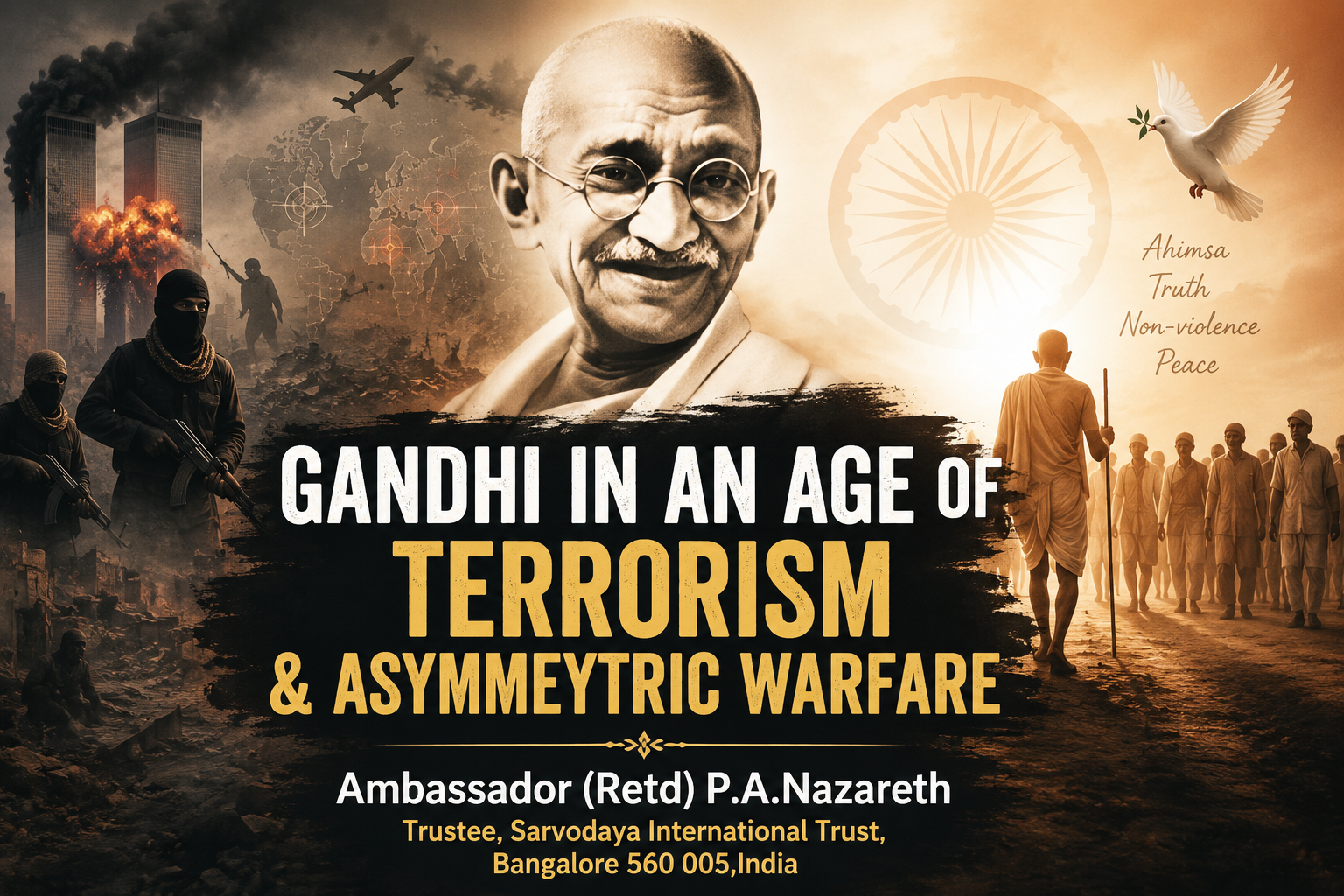
Ambassador (Retd) P.A.Nazareth
Trustee, Sarvodaya International Trust, Bangalore 560 005,India
The twentieth century was the most blood-stained in human history. Almost a hundred million were killed in two world wars, Hitler’s gas chambers, atom bomb drops on Hiroshima & Nagasaki, Arab-Israeli, India-Pakistan, Iran-Iraq, Korean, Vietnam & Afghan wars, Cambodia’s “Killing Fields”; & tribal conflicts in Africa.
In the twenty first century’s first quarter there have been terror attacks in New York, Washington, Bali, Mumbai, New Delhi, Rawalpindi, Casablanca, Istanbul, Baghdad, Djakarta, Madrid, London,
Amazingly, Gandhi had foreseen the terrorist threat early in the 20th century. Startled by the Indian revolutionaries he met in London in 1908 he wrote ‘Hind Swaraj’ & indicated that it was, “written in answer to the Indian school of violence” & offered “the gospel of love in place of that of hate & was an attempt to provide the revolutionary “something infinitely superior, while retaining his attributes of self-sacrifice and bravery”
A Gandhian approach to terrorists requires “putting ourselves in their shoes” and trying to understand why they do the things they do. This is not difficult as some of them have “farewell messages” revealing their motives. Most of them reveal outrage over foreign troops in their countries, total US support for Israeli occupation of Palestinian land/oppression of its people, and denigration of Islam in the West.
Soon after “9/11 “Paul Kennedy wrote “At 8:45 a.m. Tuesday, Sept. 11, 2001, and not the first day of the year 2000, America fully entered the 21st century. The millennial celebrations in New York’s Times Square were ephemeral acts. The devastation of the World Trade Centre, only a mile to the south, was an epic, transforming event. America is our modern-day Colossus, bestriding the world with aircraft-carriers, communications systems & giant corporations. Yet this Colossus is extremely vulnerable to weapons far different to Hitler’s panzer divisions & Yamamoto’s aircraft carriers and. It has an Achilles’ heel that is, to a great extent, of its own making. Its relentless drumbeat of free market doctrines, forcing changes upon restricted markets, blocking international agreements on climate control, & overawing Third World governments are greatly resented by the people of those countries”
Karen Armstrong echoed the same sentiment: “The world changed on September 11th. We now realize that we in the privileged Western countries can no longer assume that events in the rest of the world do not concern us. What happens in Gaza, Iraq or Afghanistan today, wll have repercussions in New York, Washington or London tomorrow and small groups will soon be able to commit acts of mass destruction previously only powerful nations were capable of”. She has also written “Fundamentalism is not going away. In some places it is either going from strength to strength or becoming more extreme. Suppression and coercion are clearly not the answer. A more just and objective appraisal of these religious movements must be sought”.
In recent years terrorism has emanated mainly from Muslim countries. In this context Samuel Huntington has written “The West’s efforts to universalize its values, maintain its military and economic superiority & intervene in conflicts in the Muslim world generate intense resentment. In the fifteen year 1980 – 1995 period, the US engaged in 17 military operations in the Middle East, all of them directed against Muslim states. No comparable pattern of US military operations occurred against the people of any other civilization.”
The 9/11 terrorist attack on the World Trade Centre in New York & the Pentagon in Washington have become the defining icons of the new era of Asymmetric Warfare. Its facts are stunning. The 18 Al Qaeda linked terrorists involved in it were armed only with box cutters, had used US flying schools to learn how to fly & US planes, US gasoline and US airports to destroy/ severely damage two of its most valuable assets, in broad daylight & just one hour!
Michael Brown, in ‘Grave New World: Security Challenges in the 21st Century’, has written about enumerates other such grave threats some of which are highly destructive ultrasonic weapons and micro unmanned aerial vehicles, “the size of a humming bird” networked to ground controls which could destroy shopping malls, railway stations and even planes by “acting as aerial mines” & a “Cyber Pearl Harbour”.
At the Nuclear Security Summit at Washington on April 2010, President Obama stated that the possibility of a terrorist obtaining a nuclear weapon represented “the single biggest threat to US security, both short–term, medium-term and long-term.”
Arne Naess and Johan Galtung had enunciated the concept of ‘non-violent social defence’ based on Gandhi’s ideas, in Norway in 1955. This established a direct link between his ideas and modern social defence theory.
In 1959, Stephen King Hall, a reputed British naval commander, in his book ‘Defence in the Nuclear Age’, had questioned the rationality of conventional military defence & urged Britain to devise a nonnuclear defence strategy. This gestated a nationwide debate & led to the 1964 Oxford Conference on Civilian Defence. Several security analysts, military strategists & non-violent resistance activists participated in it. Its outcome was a scholarly book, edited by Adam Roberts, titled The Strategy of Civilian Defense. Its American edition, published in 1968 was titled Civilian Resistance as National Defense.
A subsequent conference, held in September 1967 at Munich, probed deeper into various aspects of “trans-armament” and set up a research group headed by Theodore Ebert to make a detailed study of civilian resistance during and after the August 1968 Soviet suppression of the Czech uprising. It proposed a Social Defence strategy for Germany. This coincided with the launch of the Campaign for Nuclear Disarmament which two decades later enlarged itself into the European Nuclear Disarmament Campaign.
Paul Wehr has written “Social Defence as a concept originated in the ethical principles of the Gandhian movement, which demonstrated the power of massive noncooperation. As the destructiveness of modern war became more evident, it was natural that the principles and techniques of Gandhian noncooperation would be applied to the problem of national defense. A quarter century of scholarly research has produced a respectable body of knowledge about the underlying principles, diverse methods and practical developments of social defence….Only time and events will tell whether Gandhi’s ideas and practice will be as influential in the area of national defence as they have been in the field of social change”
Jonathan Schell, in his ‘The Unconquerable World’ has written “As the new century begins, no question is more important than whether the world has now embarked on a new cycle of violence, condemning the 21st century to repeat or even outdo, the bloodshed of the 20th.” He has stated the present dangers are not, as before, “the massed conventional armies and systematized hatreds of rival great powers” but “the persistent and steady spread of nuclear weapons and other weapons of mass destruction and the unappeased demons of national, ethnic, religious and class fury” and has averred that “notwithstanding the shock of September 11th and the need to take forceful measures to meet the threat of global terrorism, a new and promising path has opened up. For in 20th century history another complimentary lesson, less conspicuous than the first but just as important, has been emerging. It is that forms of non-violent action can serve effectively in the place of violence at every level of political affairs. This is the promise of Mohandas K. Gandhi’s resistance to the British Empire in India, of Martin Luther King’s civil rights movement in the United States, of the non-violent movements in Eastern Europe and Russia that brought down Communism and the Soviet Union”