

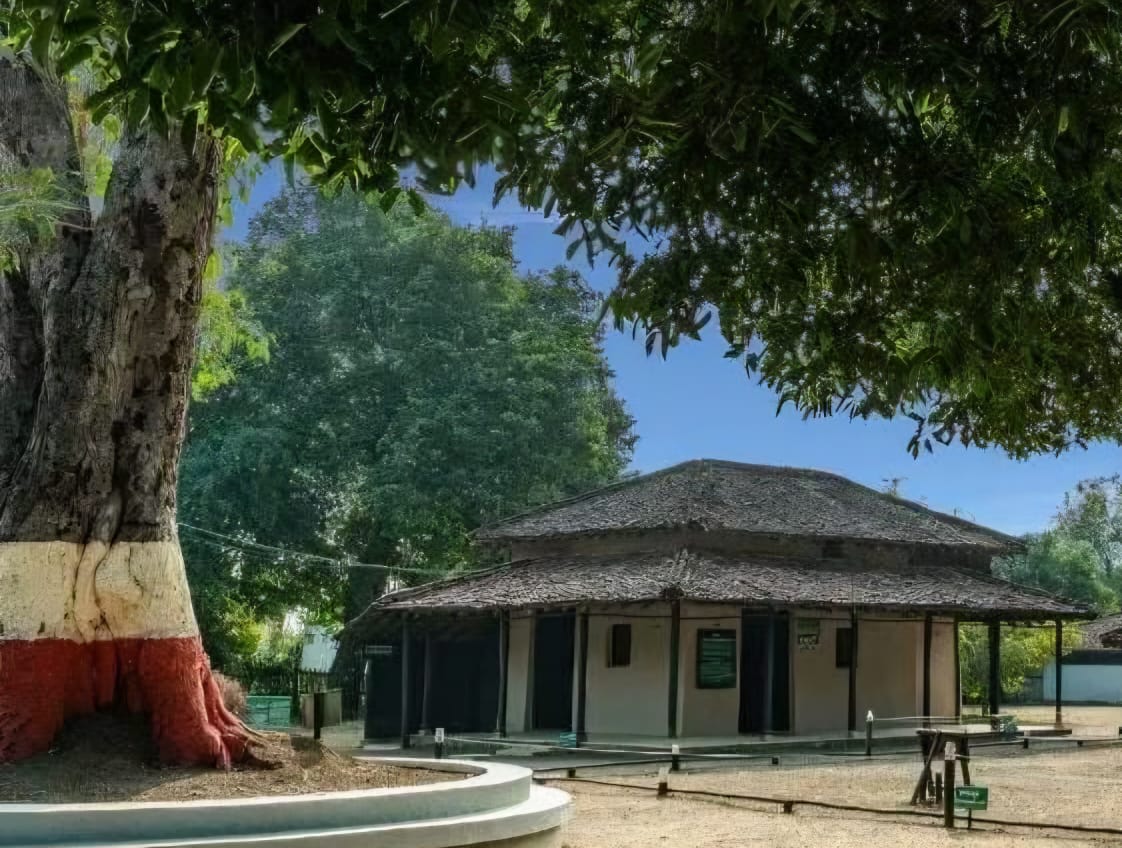
In 1936, Mahatma Gandhi decided to settle in the remote village of Segaon,. He arrived in this village on April 30 for a brief period that laid the foundation for Sevagram Ashram. Initially, he stayed in a makeshift bamboo structure, but by June, a one-room cottage was constructed for him and Kasturba according to his specific instructions. This building is now known as Adi Niwas.
In a letter to Amritlal V. Thakkar dated August 12, 1936, Gandhi illustrated the crowded conditions of this single room: “Tukdoji occupies the corner in front of me, Khan Saheb the one beside me; Munnalal by Tukdoji’s side. Rajkumari’s bed is between me and Tukdoji… Ba, Lilavati and Manu accommodate themselves where they can.” He mused on whether this “houselessness” was a trait of a true devotee, noting that despite the lack of space, Segaon was an “inexhaustible source of joy” for him.
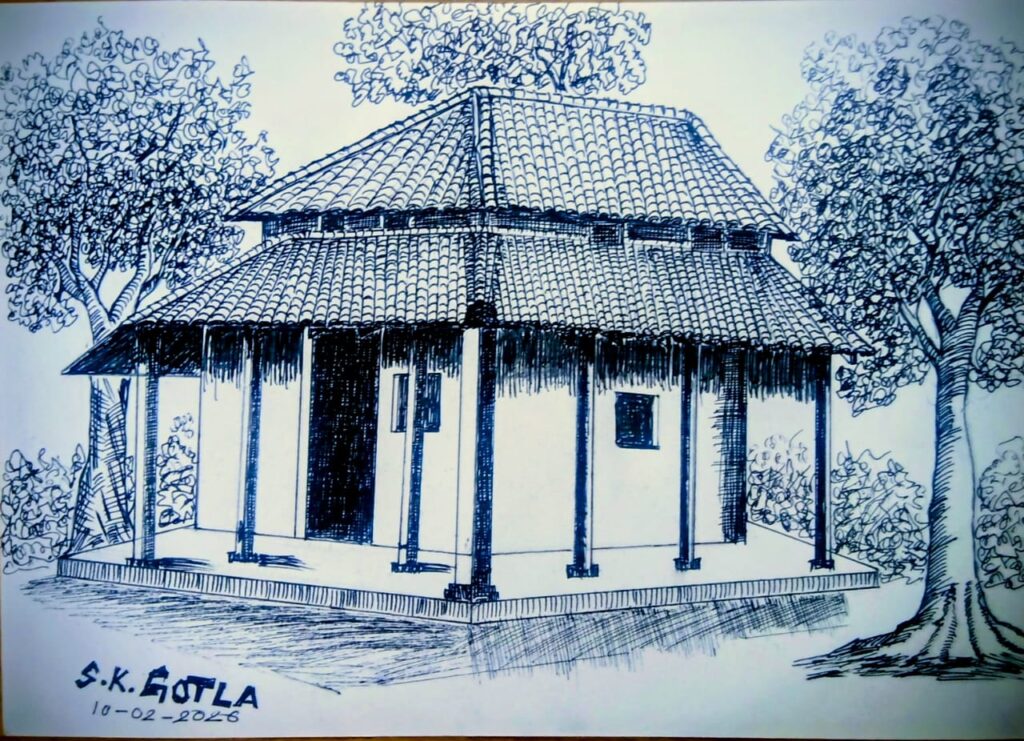
However, as captured in Balwantsinha’s memoir, Under the Shelter of Bapu, this communal living resulted in a total lack of privacy. Kasturba felt increasingly uncomfortable, telling Gandhi that the shared space felt like a “public sarai” (inn) where she had no private place to rest or change. While Bapu believed they should endure hardship as representatives of the poor, he acknowledged her need and instructed Balwantsinha to build a partition on the verandah. Using bamboo mats and poles, Balwantsinha completed the structure in just forty minutes. Gandhi then playfully presented the makeshift area to her as “Ba’s Mansion.” Although she found the solution barely adequate and accepted it grudgingly, Bapu treated the situation with lighthearted affection, as if comforting a child.
Jamnalal Bajaj realized the difficulty Kasturba faced living in such conditions. His insistence, with the Mahatma’s approval, led to the construction of a permanent, separate residence for her. This is confirmed in a letter from Gandhi to Amrit Kaur, written on the train to Bhusaval on November 3, 1936, in which he noted, “Ba’s hut is being built.”
In another letter to Amrit Kaur from Segaon, Wardha, December 11, 1936
Ba’s cottage is nearly finished. You will like it except for its somewhat city appearance. It has cost more than my hut. I am sure that at least Rs. 100 could have been saved on it. “
Kasturba Gandhi, affectionately known as “Ba,” and her cottage was known as Ba Kuti . While Mahatma Gandhi led a nation, Ba led the Ashram with quiet dedication. She played the role of a mother to the inmates. Ashram inmate Balvantsinha highlighted her maternal role, noting that her presence brought him comfort and was as “purifying as the waters of the Ganga,” leaving him feeling “orphaned” after her passing.
Her life in Sevagram ashram was an embodiment of love or non-violence through action. She stayed in this hut here with other women, often waking at 4:00 AM to sweep floors and prepare warm water for others before they woke. This “Abode of Love” reflects a woman who chose renunciation over comfort, proving that true power lies in service to others. Prabhavati, the wife of Jayaprakash Narayan, recalls her life in this hut:
“During winter days in Sevagram, I used to go into Ba’s room after the early morning 4 0′ clock prayer. And Ba always insisted: “Prabha, Go and sleep for some time”. Even in freezing weather Ba used to sweep the room; then she would heated water for the bath, and after the cleaning and dusting were over she would come to wake me up. Warm water was always ready for my bath.
Ba’s life was one replete with love, dedication, and also renunciation. When little girls like us, who attended on Bapu, went to tend on Ba, she sent us away laughingly, “I don’t need anything. Don’t tire yourself”. Even in rains Ba used to carry and clean her own chamber pot.”
The similar feelings were expressed by Balvantsinha. “Notwithstanding her old age and the rare good fortune of being the wife of a great man, she was singularly free from pride, nor did she ever entertain a thought of exploiting her position for any special amenities or advantages. She always insisted on doing her own work herself though surrounded by a multitude of girls who were eager to serve her, ‘She would not allow anyone to clean her chamber pot or commode unless she was too ill to do it herself. She always insisted on doing a part of the kitchen work with her own hands, and also looked after the sick among the Ashramites. Despite her failing health, Ba rendered some personal service to Bapuji as well. Last though not least, she kept an eye on the teen-age boys and girls of the Ashram with the loving strictness of a mother.”
She was not merely the mother of the Ashram; Netaji Subhash Chandra Bose aptly described her as “the mother of the Indian people.” “I pay my humble tribute to the memory of that great lady who was a mother to the Indian people, and I wish to express my deepest sympathy for Gandhiji in his bereavement. I had the privilege of coming into frequent personal contact with Shrimati Kasturba, and I would sum up my tribute to her in a few words. She was the ideal of Indian womanhood — strong, patient, silent, self-sufficient. Kasturba was a source of inspiration to the millions of India’s daughters among whom she moved and whom she met in the struggle for the freedom of her motherland.”
On the 22nd of February 1945, on the first death-anniversary of Ba, Gandhi was at Sevagram. “This day marks the end of a year according to the solar calendar since Ba’s departure from the earth. According to the lunar calendar the day falls on the Mahashivaratri Day. This is not an occasion for mourning. On the contrary, it should be celebrated with the same joy as a day of birth. I do not make much distinction between birth and death. Spirit has neither birth nor death. We loved Ba’s spirit which is immortal.”
Kasturba hut at Sevagram proclaims to the world the immortal spirit and the values she cherished.
Acknowledgment
This article was written to observe the 81st death anniversary of Kasturba Gandhi.
.About the Author
Dr. Siby K. Joseph is Director, Sri Jamnalal Bajaj Memorial Library and Research Centre for Gandhian Studies,
Sevagram Ashram Pratishthan, Sevagram, Wardha- 442102, Maharashtra (INDIA) and author of book Kasturba Gandhi: An Embodiment of Empowerment
Email: directorjbmlrc@gmail.com