
“We must learn to live together as brothers or perish together as fools.”
Martin Luther King Jr.
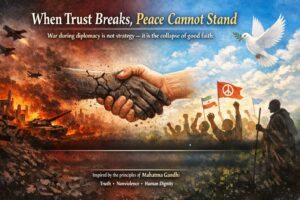
In a time of war, truth is the first casualty. But without truth, there can be no justice. And without justice, there can be no peace.
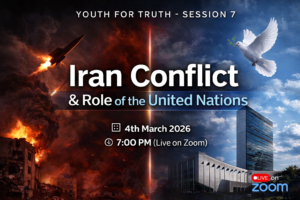
This is not simply another geopolitical conflict. It is widely regarded, under international law, as a war of aggression launched without United Nations authorisation and without the conditions required for self defence.
More troubling still, the strikes on Iran came in the midst of active negotiations.
This is not a detail. It is the central moral fracture.
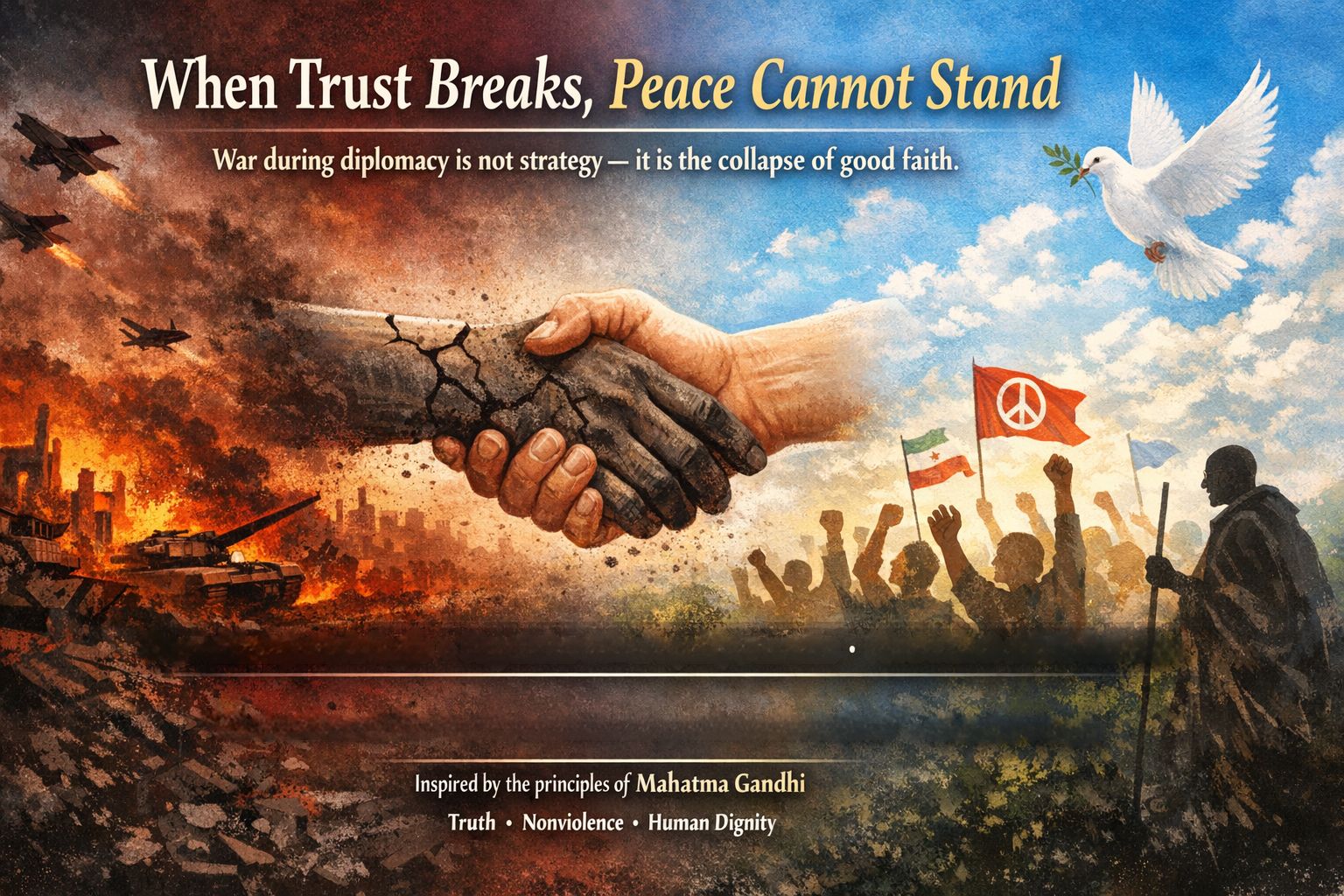
Because when war is waged during diplomacy, something deeper than conflict is broken:
Trust itself collapses.
And when trust collapses, what remains is not negotiation, but coercion dressed as dialogue.
The Collapse of Good Faith
We are told that negotiations are still possible. That diplomacy remains open.
But look closely.
The United States has presented terms requiring Iran to surrender key defensive capabilities in exchange for uncertain sanctions relief. Iran has rejected these as one sided, submitting its own demands in return.
There are no direct talks, only intermediaries, denial, and contradiction.
This is not negotiation between equals. It is negotiation under duress.
And history teaches us that peace built under coercion does not last.
There is a deeper danger here.
When agreements are sought after force has been applied, the process is no longer rooted in mutual recognition. It becomes transactional, strategic, and ultimately unstable.
As Mahatma Gandhi reminded us, violence is not justice. It is arithmetic. A life for a life, a grievance for a grievance. It does not resolve conflict. It multiplies it.
The Questions That Must Be Asked
As someone who has spent a lifetime negotiating in moments of deep conflict, I have learned that the success of any agreement depends not on power, but on principle.
So the questions before the United States, Iran, and the world are simple, but unavoidable:
• Can there be genuine negotiation after trust has been broken by force?
• Can one side demand security while denying it to the other?
• Can peace emerge from conditions that resemble surrender?
And most importantly:
What is the ethical foundation of this process?
Because without an ethical foundation, negotiation is merely strategy. And strategy without ethics becomes domination.
A Pattern the Global South Knows Well
From Africa, this moment feels familiar.
We know this pattern.
Resources extracted. Terms dictated. Sovereignty conditional. Dialogue shaped by power.
Many in the Global South do not see this war as a moral intervention, but as a failure of diplomacy and an act of aggression against a sovereign nation.
This perception matters.
Because it signals something deeper:
The erosion of international law itself.
When powerful nations act outside agreed rules, those rules lose meaning.
And when law loses meaning, the world moves closer to permanent instability.
The Deeper Danger
The danger is not only war.
It is the normalisation of war without accountability.
We are witnessing a world where:
• Wars are launched without declaration
• Negotiations are undermined by force
• Agreements are made and abandoned
• Power defines legality
This is not order. It is the slow collapse of the very system designed to prevent global conflict.
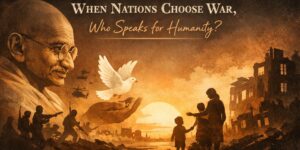
And beneath it all, something more human is being lost.
The weeping of mothers.
The silence of children who no longer know how to play.
The quiet grief of those who have outlived too much.
These are not abstractions. They are the true measure of our failure.
No cause is so holy that it may be built upon the suffering of the innocent.
South Africa’s Lesson
South Africa faced its own moment of reckoning.
We negotiated with those who oppressed us. We sat across the table from power that did not recognise our full humanity.
Yet we rose above our constituencies and found common ground in a shared vision of freedom, anchored in one person, one vote, in a democratic and nonracial South Africa.
One principle guided us:
You cannot negotiate peace while humiliating the other.
If we had pursued domination, we would have descended into civil war.
Instead, we chose an imperfect but shared future.
That is the lesson the world must remember now.
Ubuntu and the Possibility of Another Path
Africa offers something the current global system has lost:
Ubuntu.
“I am because you are.”
Not as sentiment, but as strategy.
Ubuntu recognises that security is mutual. That dignity is indivisible. That peace cannot be imposed.
In the current conflict, this means something very practical:
• Security guarantees must be reciprocal
• Sovereignty must be respected
• Negotiations must be conducted in good faith
• No nation can be asked to accept permanent vulnerability
Without these, there is no peace.
Only a pause between wars.
What This Moment Demands
This is not a call to take sides.
It is a call to restore principle.
If the world is to step back from escalation, several truths must be faced:
- War cannot replace diplomacy, especially not when diplomacy was already underway
- International law must apply equally to all nations, or it ceases to exist
- Negotiation must be based on dignity, not coercion
- Global governance must be reformed so that no single power can act with impunity
This moment demands moral courage.
Not the courage of the battlefield, but the courage to step back, to listen, and to recognise the humanity of the other.
A Choice for Humanity
This moment is bigger than Iran and the United States.
It is about the kind of world we are becoming.
A world where might defines right.
Where agreements are disposable.
Where war becomes routine.
Or a world grounded in first principles:
Human dignity.
Mutual respect.
Shared security.
Africa, as the cradle of humankind, carries a memory the world has forgotten:
That we are not enemies.
That we are bound together.
That peace is not the victory of one over another, but the recognition that our futures are inseparable.
Final Reflection
If negotiations are to succeed, they must begin not with demands, but with a simple restoration:
Good faith.
Without it, there will be no agreement.
Only the continuation of war by other means.
And history will record that, in a moment when humanity stood at a threshold, we chose power over principle and paid the price.
“If you want to make peace with your enemy, you have to work with your enemy. Then he becomes your partner.”
— Nelson Mandela