
Cynthia Lukas
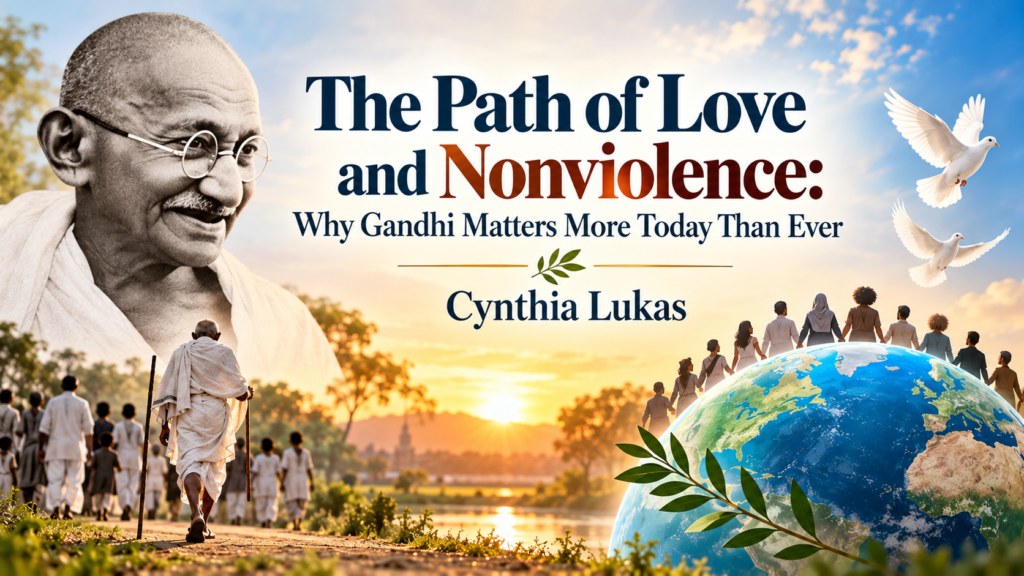
Thank you very much, Dr. Siby K. Joseph and Dr. Michael Sonnleitner, for those wonderful introductions. I am truly deeply honoured to be here among such esteemed speakers, presenters, and organizers today. I would also like to extend my warmest greetings to all the peace fellows joining us from around the world. I am really excited that you have made this commitment to deepen your understanding of Gandhi, nonviolence, and conflict resolution.
I wanted to begin by sharing that brief clip from Gandhi’s Awakening—one of the two documentaries I have made on Mahatma Gandhi—to give you a small glimpse into the work I do as a filmmaker. Released in 2018, this film focuses on the early years of Gandhi and Kasturba in South Africa. For nine years, it has been broadcast on PBS channels, the largest documentary market in the United States, alongside its companion piece, Gandhi’s Gift, which covers the final four years of his life.
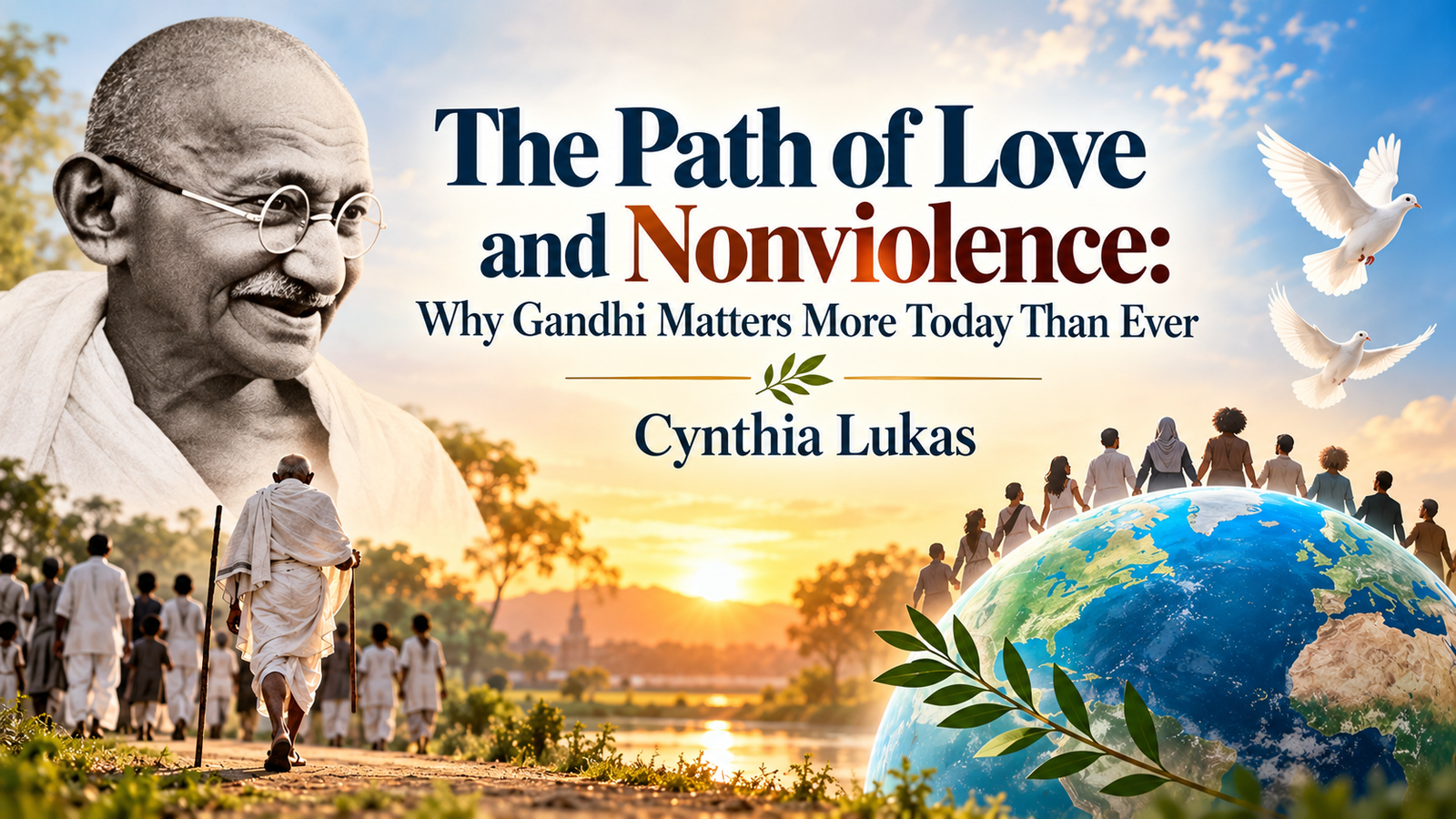
What moves me most about the clip we just watched is the profound quotation from Dr. Martin Luther King Jr., recorded around 1959. He said, “If this age is to survive, it must follow the way of love and nonviolence that he so nobly illustrated in his life.” Decades later, amidst our current global crises, these words remain relevant still. If our age is to survive, it must follow the path of nonviolence. This brings forward a central theme in all of my films: that Gandhi is perhaps even more important today than when he walked the earth. He lived through the chaos of World War I and World War II, fighting for the liberation of India in a deeply challenging era. Yet, today, carrying forward his legacy through initiatives like this fellowship program is more vital than ever.
The film excerpt also references the profound awakening Gandhi experienced in South Africa. Thrown off a train in the middle of the night for sitting in first class—a direct result of hatred and prejudice—he found himself entirely alone on a cold platform. But as I have reflected on that moment over the years, I realized he wasn’t truly alone. He was in the dark night of his soul, actively wrestling with his reality and his Truth. He had to decide how he would respond to the personal violence perpetrated against him. Later, he would famously state that “Truth is God.”
This is an experience we all face to some extent. Whether we suffer violence, hatred, prejudice, and injustice personally, or witness it happening to others, we eventually confront a personal crossroads. We must ask ourselves: “How are we going to think, speak, and act in the face of violence? Are we going to remain nonviolent?” For Gandhi, his truth required him to live differently from that day forward. It was not an overnight transformation, but a conscious decision to begin his lifelong evolution, or “Experiments with Truth,” as he later called them.
My own awakening regarding violence came as a teenager during the Vietnam War. Unlike some of our esteemed speakers today who have experienced the direct unrest and violence of war within their countries, my experience was as a witness from afar. Gandhi himself knew the physical reality of war personally; he served as a stretcher-bearer, carrying the wounded during the Boer War and the Zulu rebellion, and he survived physical assaults three separate times in South Africa due to his nonviolent stance. For me, witnessing the brutality of the Vietnam War through the powerful journalism of that era left an indelible mark. I saw that war is cruel, harmful, and tragically unnecessary because there is always another way.
At that young age, I decided I would dedicate my life to promoting peace and nonviolence, although I wasn’t sure how. When I discovered Gandhi’s writings later in life, his words resonated with me instantly. Principles like “nonviolence is a weapon of the strong,” and the understanding that “nonviolence and truth are inseparable,” struck a deep chord. His nonviolence was rooted in the fundamental truth of our common humanity. As Dr. King, our nonviolent prophet in the United States, beautifully summarized: “The ultimate weakness of violence is that it is a descending spiral, begetting the very thing it seeks to destroy.” Once violence begins, nonviolence is the only force capable of stopping it.
My early realization shaped my entire journey. It led me to work as a journalist, to serve two terms as a local politician on a city council during the highly volatile period following September 11, and to teach as a college educator. It was against the backdrop of 9/11 that I directed my first major interfaith film, Rumi Returning, which began airing on PBS in 2007. I was blessed to travel to Turkey three times to produce it, creating an educational celebration of mystical Islam at a time when the Muslim community was under severe siege and facing immense prejudice in the West.
The weight of that period was felt heavily in my own community. Just two days after 9/11, a Sikh man was tragically murdered in a neighbouring town simply because his attackers mistakenly thought he was Muslim. Experiencing that local eruption of hatred reinforced my commitment to this work. Following that, I produced my second major interfaith documentary, The Globalized Soul, which focused on the Parliament of the World’s Religions. That gave me the beautiful opportunity to travel to India for the first of three times and film the historic Jain temples in Palitana.
We were the first Western journalists allowed to film those temples in Palitana, I learned deeply about Jainism. This was a profound honor because, as many of you know, Mahatma Gandhi had a Jain mentor who deeply influenced his understanding of nonviolence. I was also fortunate to travel to Jerusalem to interview Sheikh Abdul Aziz Bukhari, the founder of the Jerusalem Peacemakers—an organization now known as the Abrahamic Reunion, which is stronger and more vibrant today than ever. It is a dedicated grassroots organization working to bring all faiths together to foster inter-religious harmony and peace in that volatile region.
After I interviewed Sheikh Bukhari, he sadly passed away, but he had graciously invited us to his home, where his wife welcomed us. His entire life had been dedicated to creating peace between Jews and Muslims in Jerusalem. When I walked into his home, the very first thing I saw hanging in the hallway was a picture of Mahatma Gandhi. It was a deeply moving moment because I instantly knew where his nonviolence had drawn its inspiration. Gandhiji’s extensive efforts to create inter-religious harmony and true friendship among people of different faiths have always held my heart. I see my earlier two films on interfaith unity, alongside my career as a journalist, educator, and city councilwoman, as the natural path that led me to document the lives of Mahatma Gandhi and his wife, Kasturba. I truly feel everything in my life was leading me to this work.
I was also blessed to travel to South Africa while filming Gandhi’s Awakening, so I want to give a special shout-out to our fellows joining us from South Africa today. You have a beautiful country with beautiful people. While there, I was able to film the very train station where Gandhi was thrown from the first-class carriage. I also filmed inside the prison cell where Kasturba was held. Let me tell you, it was a brutal, unforgiving place, as were all the prisons the Gandhis endured across South Africa and India.
In my biographies of the Gandhis, I make a deliberate effort to explicitly connect their foundational spirituality to their politics. This is something I do differently from many other documentarians, because trying to talk about Gandhi without discussing his deep spiritual basis simply does not make sense.
Additionally, my films bridge these historical figures with modern, contemporary activists who courageously follow in their footsteps. I feature expert commentators whose recent research reveals a vital truth: nonviolent movements are far more successful than violent ones. This is a critical piece of information I hope to educate the public about, as many people still mistakenly believe that change requires physical force, guns, and weapons. The data proves otherwise.
In fact, modern research shows that nonviolent movements rarely fail when they mobilize just 3.5% of the population as active participants. This is an incredibly hopeful statistic for the world because it proves you only need a committed minority to fundamentally transform a society. Furthermore, data reveals that nonviolent movements achieve even greater success when there is high participation from women. This is because women are natural networkers who excel at building community coalitions, drawing in up to seven times more participants.
Gandhiji understood this power. He connected with many nonviolent women leaders throughout his life. He visited and learned from the Quakers in England, admired the British suffragettes, and closely studied the Irish Ladies’ Land League. In the autumn of 1880, Irish tenant farmers and the local community led what became the very first “boycott” by withholding their services and cooperation from a land agent named Captain Charles
Boycott, bringing his operations to a complete halt. Gandhiji later studied these Irish Land War tactics and integrated their non-cooperation methods into his own philosophy of Satyagraha and hartals.
He actively called upon women to join the freedom struggle, and Kasturba went out to the villages to recruit them. They were absolutely essential to the Indian movement for independence and social uplift. In 1930, following the historic Salt March, Gandhiji famously stated: “If nonviolence is the law of our being, then the future is with women.” By this, he didn’t just mean women leading the charge; he meant that the future belongs to what have historically been viewed as womanly virtues—most notably, compassion. Gandhiji himself used to pray to be made “more womanly,” by which he meant more deeply compassionate.
This philosophy brings us to the core concept of Sarvodaya—the welfare and uplift of all, ensuring no one is left behind—and his call for voluntary simplicity. One of my favorite statements of his is that “the world has enough for everyone’s need, but not enough for everyone’s greed.” This directly addresses what it means to be a responsible global citizen. We must live simply so that we do not strip resources away from those living today or from the generations yet to come.
Gandhiji also possessed a surprising relevance on matters he anticipated long ago, particularly environmentalism. He was fiercely strong-minded about living sustainably and in perfect harmony with nature. His disciple, Mirabehn, alongside others, went on to inspire one of the early “tree-hugger” movement in India, which effectively laid the groundwork for the modern global environmental movement.
Finally, Gandhiji championed the absolute vital importance of the freedom of the press. He was a working journalist his entire life. On an occasion when he had to suspend his publications, he spoke about how each of us must become “walking newspapers.” This concept was brought to my attention by my dear friend and expert commentator, Dr. Rajmohan Gandhi. In his book Why Gandhi Still Matters, Dr. Rajmohan points out how relevant this idea is to our modern era of social media. Gandhiji’s values for a “walking newspaper” demand that we meticulously verify the sources of what we report, write, and speak, and that we strictly refuse to engage in idle gossip. All of these enduring values that I have mentioned are precisely what we need to bring about lasting global change.
Mahatma Gandhi had a brilliant way of bringing spiritual values directly into politics. He famously remarked that politics was like wrestling with a snake—but he believed someone had to do it, and he was willing to step into that ring. Through it all, he held onto a foundational belief that I find deeply hopeful: Truth will be victorious. It might not triumph in the short run, or in the exact way we would prefer, but it will prevail in the long run. Our role is simply to remain resilient, focused, and hopeful.
Keeping our focus on Truth is absolutely vital for today’s world. As an educator and filmmaker, that is exactly what I try to do. My documentaries are designed to bring these
essential truths forward—to educate, but more importantly, to inspire people to reflect on Gandhi’s ideas, his legacy, and his values. Gandhi reminds us to turn a searchlight inward, to look deeply at our own truth, and to let that inner truth guide how we think, speak, and act. That inward reflection is the ultimate foundation of nonviolence. It has been a profound inspiration for my own life, my political activism, and my documentary work. (For those interested in exploring this further, my latest film and my films on Gandhiji can be found at kasturbagandhi.org).
Ultimately, I make these films to inspire audiences. I believe each of us, within our own communities, can watch a film or witness the activism of others and be inspired to emanate positive energy in our own spheres. From that energy, we can take positive action locally, whatever form that action may take.
You may not be called to participate in a satyagraha (non-violent resistance) every day of the week—and you won’t be. But on a daily basis, you can work in the sphere of sarvodaya, which was Gandhi’s concept for the upliftment of all. This daily, grassroots effort is exactly how Gandhi prepared himself for larger movements. You train yourself for major actions by engaging in social, humanitarian, and charitable work every single day. To truly change things, you must bridge both the political and the social.
Gandhi’s vision for this was what he called the “oceanic circle.” This is not a top-down pyramid with leaders at the apex and everyone else struggling at the bottom. Instead, it is a series of ever-widening, never-ascending circles. At the very center sits the individual and the village community—always connected. While the individual is at the center, they are completely aware of, and responsible for, their village, their community, and the broader world.
This brings us right back to the concept of being a global citizen. Even though Gandhi was deeply involved with India—a country he loved entirely—his work was meant to serve as an example for the rest of the world. Today, we can take that vision into our own communities and countries. I am seeing more and more grassroots efforts occurring globally, with an incredible wave of women getting involved for the very first time. I hear so many people say, “I’ve never done anything before, but now I am.” This is exactly how change starts, wherever you are.
This must be our shared vision. I want to close by echoing the words: Jai Jagat!—Victory to our world.
When we achieve victory and upliftment in our own local communities, it becomes a victory for the entire world because we are all interconnected. By doing this work, we become living examples to others who are still struggling and looking for the way forward.
Thank you everyone for listening. To the fellows here today, I hope that your next four months are nothing less than transformational—as I am absolutely certain they will be.
Thank you, everyone.
Note: This is a transcript of a speech delivered by Cynthia Lukas as the guest of honour at the launch of the 5th International Online Fellowship Program on Nonviolence and Peace (IFPNP) on the International Day of Nonviolence, October 2, 2026. The transcript was edited by Dr. Siby K. Joseph, the director of the program.