Dr. Siby K. Joseph
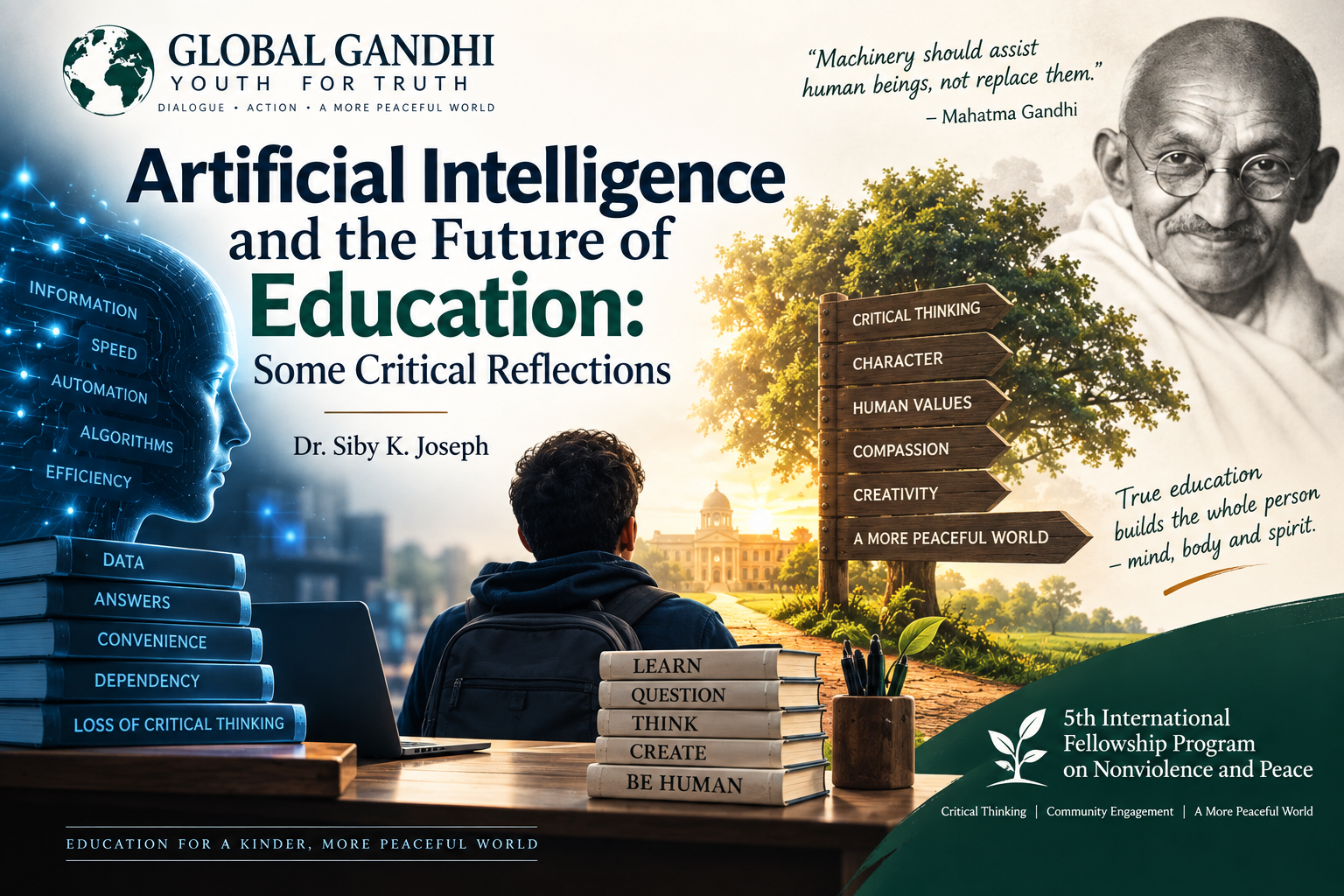
On this Teachers’ Day, Prof. M. Raisur Rahaman has beautifully narrated the power of education to shape the human spirit from the perspective of Mahatma Gandhi and Dr. S. Radhakrishnan in the AI age. From his presentation, it is clear that we find ourselves standing at a critical crossroads. We are living in a world dominated by Artificial Intelligence. A deep fear has been created in the minds of even the academic community that if one is not fully aware of the intricacies of new AI learning systems, they will become outdated or lag far behind in their research and academic pursuits. This creates widespread anxiety among both students and teachers because our current educational system fails to equip individuals for the emerging future. Technological changes are happening so rapidly that the moment students finish their studies, they realize the knowledge they gained has already become obsolete in the evolving society they are supposed to fit into. This induces a paradoxical situation where we are constantly forced to chase after AI and new technological developments.
Consequently, true wisdom, character building, and the inculcation of human values are no longer priorities in this shifting paradigm. The machine age is actively redefining human values and the very goals of life. Human beings have been pushed to a secondary position, while machine knowledge has become the primary driving force. This has led to an endless race to update our skills simply to avoid being replaced by automation.
Through the systematic propaganda and advertisements of the corporations that develop AI systems, we have become trapped in this cycle, which causes immense psychological and cognitive risks. By outsourcing our thinking abilities to AI, we directly alter our brain’s functioning. For example, before the arrival of calculators, all calculations were done manually, and mathematics was at people’s fingertips. Now, however, we depend heavily on calculators and have largely lost that innate cognitive ability.
The human brain is highly adaptable—a phenomenon known as neuroplasticity. The core principle of neuroplasticity is simple: “use it or lose it.” When we stop regularly practicing deep thinking, the neural pathways required for critical reflection, memory retrieval, and complex analysis weaken, causing our cognitive skills to shrink. If your thinking process is continuously executed by someone else—even if that someone else is an AI—dependency eventually becomes a habit. This creates a dependency syndrome that stifles the inherent human capacity for critical thinking, writing, analysing, and problem-solving.
Furthermore, when you hand over your thoughts to an AI, it reshapes your views to align with a predominant capitalist worldview and its inherent biases and philosophy of life. True compassion and empathy are entirely missing from its code. Instead, the AI moderates your critical analysis to serve the philosophical and financial interests of the corporations that built it. Another major flaw is the “language of the machine”: the first-person “I” is missing, replaced by an artificial neutrality that fails to reflect your personal convictions.
Ultimately, AI-assisted research creates a false sense of accomplishment—the illusion that one no longer has to do any actual work. In this process, the rigorous, painful journey of traditional research—which is exactly what transforms and evolves human thought—is completely lost. Academic institutions have introduced AI detectors to check its usage, yet AI tools have adapted by offering “humanize” options. However, selecting a “humanize” option to avoid detection remains a purely mechanical act of machine thinking. The original spark of your initial prompt is lost, replaced by a hollow simulation. The result is a debilitating dependency that makes individuals feel incapable of independent thought. By surrendering to this dependency syndrome, we ultimately allow ourselves to be trapped, transforming from independent thinkers into mere tools of the machine’s biased and systemic logic.
To overcome this trap, we find crucial clues in Mahatma Gandhi’s approach to machinery and human labour. Machinery should assist human beings, not replace them. Human labour, or work, is a profound expression of the self that ultimately helps us realize our true purpose and the core truth of human existence. It remains an undeniable fact that true education cannot be found in the corporate algorithms of the machine age, but rather in the holistic cultivation of human character through the harmonious blending of body, mind, and spirit. In this process, if students and teachers alike are to reclaim their intellectual sovereignty (Swaraj), they must resist the temptation of easy paths and return to the rigorous, independent thinking dictated by the heart rather than just the intellect. In asserting this, I am not completely negating the use of AI; rather, we must strictly define where and how it should be used.
It is precisely here that the teaching community must step in. We must draw upon our collective experience and years of academic accomplishment to steer technology back into the service of humanity, rather than letting humanity become a tool of the machine.
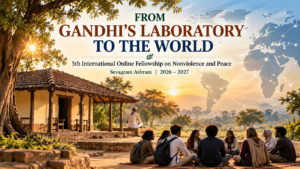
This is exactly why we are launching the 5th Annual International Online Fellowship Program on Nonviolence and Peace today. This fellowship is not a space for passive consumption or automated answers. It is a rigorous, four-month journey designed to cultivate critical thinking, real-world community engagement, and true nonviolent conflict resolution.
I invite the young minds of our network to reclaim their independent thought, resist cognitive dependency, and join us in building a future rooted in genuine human values.
Thank you, and a very happy Teachers’ Day to you all.
Note: This reflection was prepared for discussion by Dr. Siby K. Joseph, an academic and Gandhian scholar, on the occasion of Teachers’ Day for the monthly dialogue series hosted by Global Gandhi – Youth for Truth, where the International Fellowship Programme on Nonviolence and Peace was formally launched. He is one of the founding members of the Global Gandhi Network, the Director of the International Fellowship Programme on Nonviolence and Peace, and is deeply involved in training young people both nationally and internationally.