
Siby Kollappallil Joseph
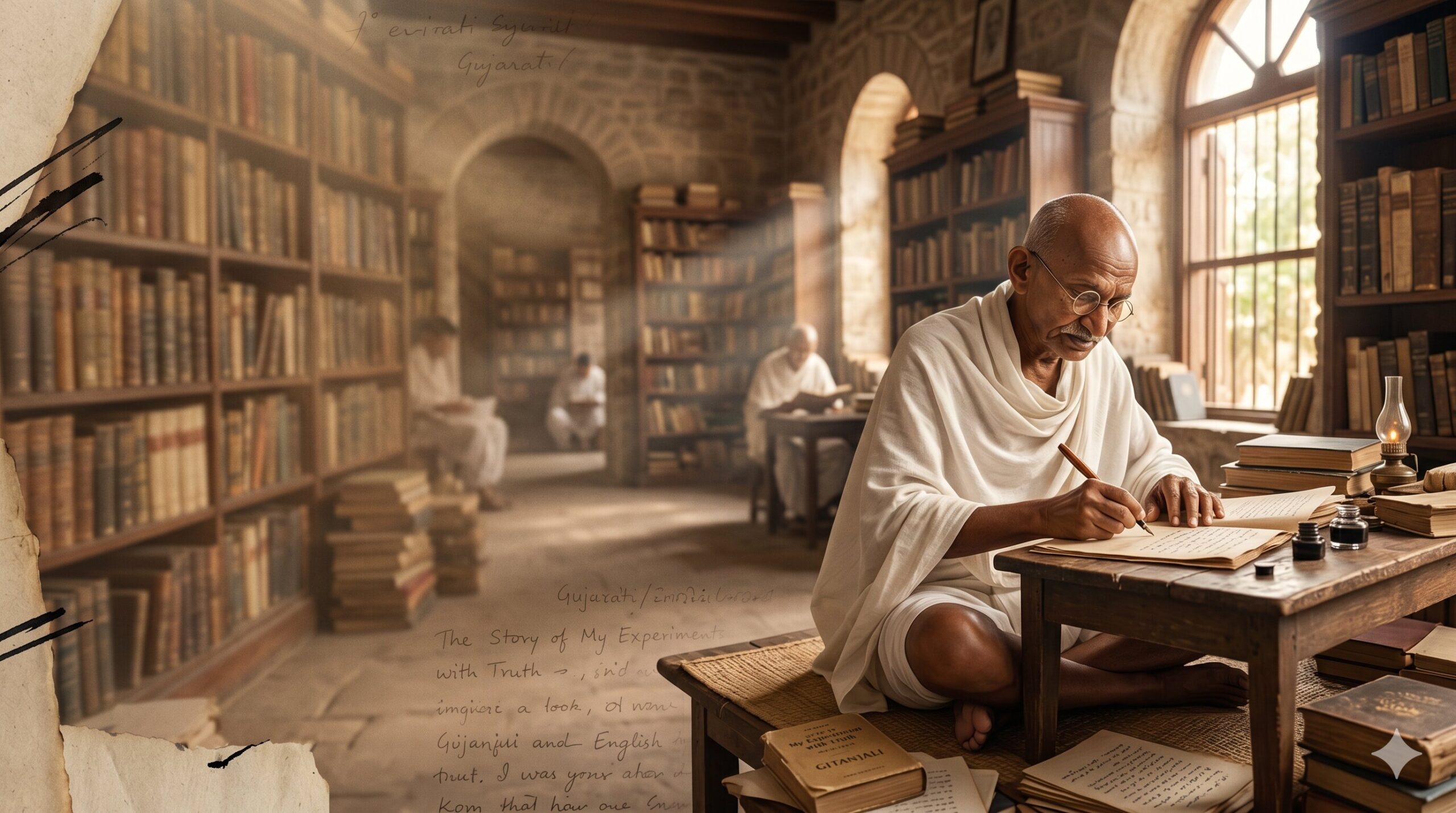
As we observe World Book Day on April 23, 2026, it provides a meaningful opportunity to reflect on Mahatma Gandhi’s profound relationship with the written word.
Although Gandhi was not an academic who lived solely in the world of theory, he was deeply immersed in the literary world and made extraordinary contributions to it. At his core, he was a spiritual seeker who was drawn into the political arena by the circumstances he confronted in both South Africa and India. Through this journey, he developed a unique philosophy that eventually earned him the global status of a philosopher. All of his writings were the result of specific circumstances, the demands of the time, or reflections on current issues. Gandhi never practiced “writing for the sake of writing.” Instead, every word was a purposeful response to the world around him. His writings were never mere intellectual exercises; they were “experiments with truth” aimed at serving humanity.
The First Literary Attempt: Guide to London
Hind Swaraj (1909) is widely recognized as Gandhi’s first major published work, but he actually penned a detailed travel guide titled Guide to London much earlier, between 1893 and 1894. Although it remained unpublished during his lifetime, it is historically considered his first-ever book.
Gandhi wrote this handbook to help fellow Indians navigate life in the UK, drawing from his own experiences as a law student from 1888 to 1891. In his introduction, Gandhi wrote:
“The only reason why I write the book is that no one has as yet written it, though [it is] badly wanted.”
Thus, his first literary attempt was born out of a practical necessity to help others. By way of conclusion, he wrote:
“I beg [all to] extend me their co-operation, i.e., help me by buying and, what is more necessary, reading the book so that they may help themselves… The province of the book is not to collect information from the existing books, but to attempt that which has not yet been attempted.”
Consequently, his first foray into writing was not meant to merely aggregate existing information, but rather to fill a gap in the literature by providing original, practical, and lived insights.
A Vision Forged in Conviction: Hind Swaraj
While Gandhi’s Guide to London was born out of practical necessity, his seminal work, Hind Swaraj, was an expression of the deeper convictions he internalised from reading the 20 classical works listed in the book’s appendix. This list includes influential authors such as Leo Tolstoy (who had six entries), John Ruskin, Henry David Thoreau, Giuseppe Mazzini, and Plato.
He wrote this tract of thirty thousand words in a short span of just ten days. This occurred during an illuminating voyage from London back to South Africa aboard the ship SS Kildonan Castle, following what he felt was a disappointing and abortive mission to advocate for the Indian cause in London. As Gandhi himself noted in his “Word of Explanation,” the book was a direct response to the “Indian school of violence and its prototype in South Africa.”
Gandhi wrote with a sense of urgency, his ideas formulating faster than his pen could capture them. The intensity of the task was such that he used both hands to complete the 275-page manuscript; when his right hand grew tired from constant writing, he switched to his left. Of the final manuscript, approximately 40 pages were written with his left hand. Upon completing this landmark work, Gandhi felt he had produced something truly original—a vision for India that replaced hatred with a “gospel of love” and violent resistance with the spiritual force of Satyagraha.
Documenting the Soul: Satyagraha and Atmakatha
Before chronicling his personal spiritual journey, Gandhi wrote Satyagraha in South Africa, which he began in 1923 while imprisoned in Yerwada Jail. While his autobiography was a deeply personal story, this earlier work served as a historical record of the political movement he led for over twenty years. He intended it to be a guide for future struggles, documenting the “truth-force” that transformed him from a shy Inner Temple barrister into a leader of the Indian masses.
Gandhi’s own words in the preface clearly define his purpose:
“My only object in writing this book is that it may be helpful in our present struggle, and serve as a guide to any regular historian who may arise in the future.”
In contrast, Gandhi’s autobiography arose from a deeply personal crisis. The immediate catalyst was a “moral lapse” among residents at the Sabarmati Ashram in November 1925, which compelled him to fast. During this time, a “still, small voice” led him to lay bare his life before God. In the original Gujarati, Gandhi distinguished between jivan vrutant (a chronicle of life) and atmakatha (the story of a soul). While the English translation “autobiography” often blurs this distinction, Gandhi’s true intent was to share the spiritual journey of his soul rather than a mere historical record.
Reading as Sadhana
The number of books Gandhi authored was relatively small; however, his vast body of journalism and correspondence eventually filled 100 volumes of the Collected Works of Mahatma Gandhi. Even today, researchers and archivists frequently identify letters and documents that were not included in the original publication.
In the book Gandhi and the Centrality of Ethics by K.P. Shankaran, which I edited, the chapter titled “Reading as Sadhana: Gandhi’s Experiments with Truth” brings Gandhi’s intellectual journey into the limelight. Shankaran illustrates that for Gandhi, reading was not a passive hobby but a disciplined spiritual practice—a sadhana—integral to his pursuit of truth.
The author notes that after establishing the Satyagraha Ashram in 1915, Gandhi made meticulous arrangements for his books, including a dedicated section for his friend, Hermann Kallenbach. In 1917, he relinquished personal rights over this vast library, making it part of the ashram’s collection. Later, in 1933, he donated nearly 11,000 volumes to the Ahmedabad Municipal Library. While the Bibliography of Books Read by Mahatma Gandhi lists 4,500 specific titles, it offers profound insight into a leader who viewed the written word as a vital tool for transformation.
Conclusion
Mahatma Gandhi’s life proves that the power of a book lies not just in its reading, but in its application. This transformative journey began when he established the Phoenix Settlement after reading John Ruskin’s Unto This Last—an experience he famously described as the “magic spell” of a book. By treating reading as a sadhana, he was able to discover his own deepest convictions mirrored in the great works of others. On this World Book Day, we remember Gandhi as a seeker who proved that reading with purpose is the first step toward transforming both oneself and the world.
About the Author
Dr. Siby K. Joseph is Director, Sri Jamnalal Bajaj Memorial Library and Research Centre for Gandhian Studies, Sevagram Ashram Pratishthan, Sevagram,Wardha- 442102, Maharashtra (INDIA)
Email: directorjbmlrc@gmail.com