
Just hours before his assassination on January 30, 1948, Mahatma Gandhi delivered a final message: even the atomic bomb must be met with non-violence. I had the opportunity to read about this historic encounter in a weekly publication from Kerala, which reached me just two days ago as we are witnessing the ongoing U.S.-Israel war with Iran.
The article—a translation of a chapter from Margaret Bourke-White’s 1963 book, Portrait of Myself—strikes a deep chord during this current crisis. The joint military operation by the U.S. and Israel resulted in the assassination of Iran’s Supreme Leader, Ayatollah Ali Khamenei, on February 28, 2026. Reports indicate a devastating humanitarian toll, including the deaths of nearly 170 children following a strike on a girls’ elementary school in southern Iran.
At the historical juncture of Gandhi’s interview, America was the only country that possessed nuclear weapons. Seeking guidance from the “apostle of non-violence,” Bourke-White observed that while mankind held the key to ultimate destruction, Gandhi offered a different path. When asked if America should stop manufacturing the atom bomb, he replied unhesitatingly: “Certainly America should stop.” He emphasized that “bad means could never bring about good ends,” arguing that a peaceful world cannot be built using tools of mass destruction.
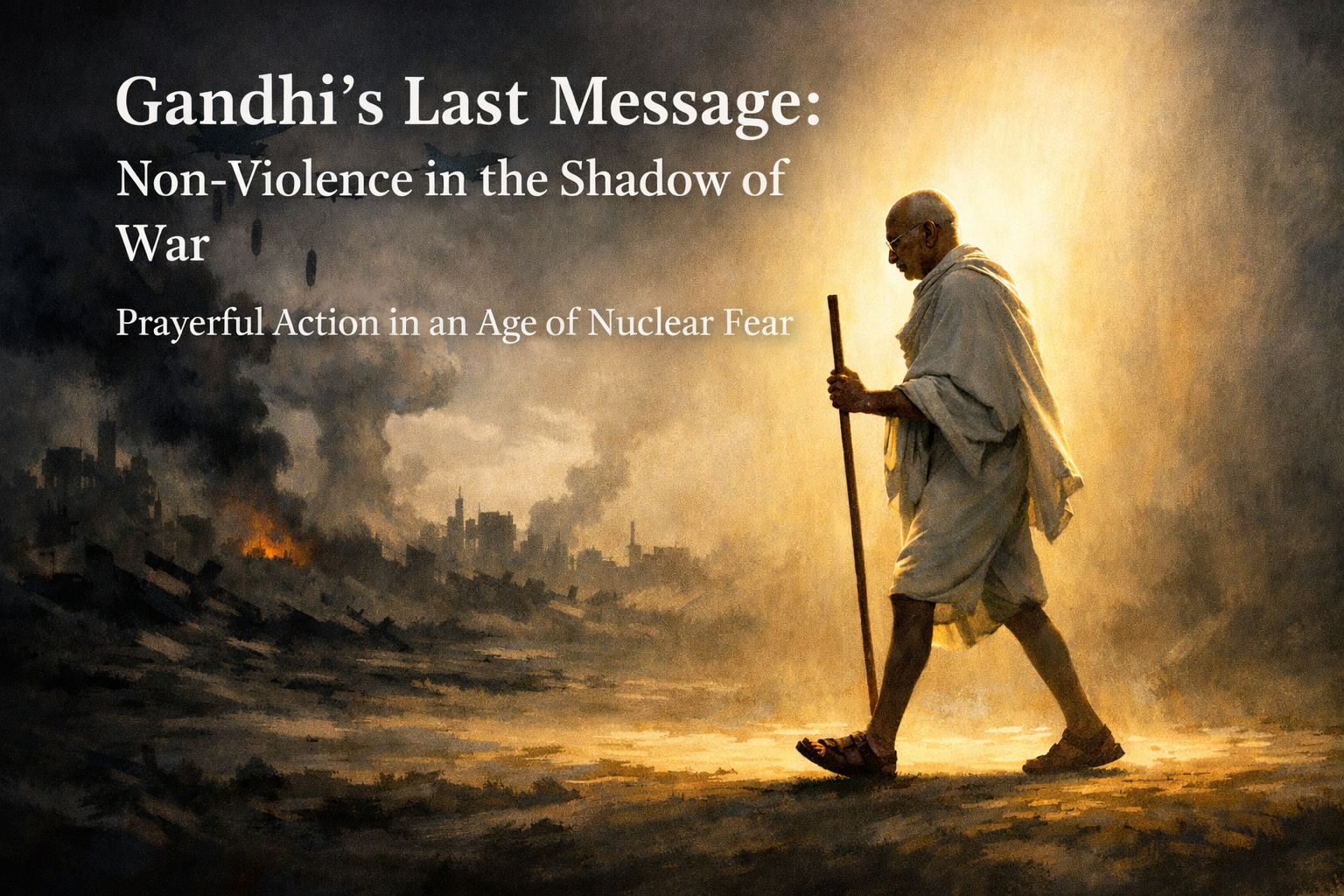
When Bourke-White probed the “dreadful problem” of how to meet such a weapon, Gandhi answered with profound sincerity: “I would meet it by prayerful action.” He explained that he would not hide in shelters or go underground, but would “go out and face the pilot so he will see I have not the face of evil against him.”
Even while acknowledging that a pilot might not see a face from such a great height, Gandhi maintained that the “longing in our hearts that he should not come to harm would reach up to him, and his eyes would be opened.” Reflecting on the tragedy of Hiroshima, he lamented that if the victims had died with that prayer in their hearts, the war would not have ended so disgracefully. He warned that in such conflicts, it is a question of “whether the victors are really victors or victims… of our own lust and omission.”
As his voice sank to a whisper during those final hours, his words remain hauntingly relevant today: “The world is not at peace. It is still more dreadful than before.” Looking at the innocent lives lost in Iran, we are reminded that Gandhi’s vision of non-violence was not a refusal to act, but a courageous refusal to mirror the evil of the aggressor. In the shadow of these recent tragedies, we must honor Gandhi’s last message by demanding an immediate ceasefire, choosing the difficult path of “prayerful action” over a “disgraceful” cycle of destruction that may ultimately lead to nuclear war.
To implement Gandhi’s “prayerful action” as a tool for a modern ceasefire, we must shift from passive observation to active, moral resistance that appeals to the global conscience. We must publicly mourn all victims—including the 170 children lost in Iran—to demonstrate that “bad means,” such as the bombing of schools, can never lead to a “good end.” In these dark times of war, we cannot hide from reality or retreat into silence; instead, we must stand in the “open” and refuse to accept state-sponsored violence as “inevitable.” Since modern decision-makers cannot see the faces of the innocent from their heights, we must use our global connectivity to bring those faces directly to their screens and doorsteps.
Gandhi warned that victors often become victims of their own “lust.” Today, citizens must demand that their governments end the “omission” of silence. Calling for an immediate ceasefire is the ultimate act of “prayerful action” because it prioritizes the sanctity of life over the lust for victory. Now is the time to advocate for the cessation of all arms manufacturing—especially nuclear weapons—and the redirection of military funding in every nuclear-armed nation. Only a unified global moral stance—a collective “prayerful action” for peace—can create the spiritual and political pressure necessary to make the continuation of this “disgraceful” warfare impossible for any leader to sustain.
About the Author
Dr. Siby K. Joseph is the Director of the International Fellowship Program on Nonviolence and Peace. He is engaged in promoting Mahatma Gandhi’s message of nonviolence to the global community through various initiatives and networks, including Global Gandhi